Why Smarter Corporate Air Travel Matters in 2026

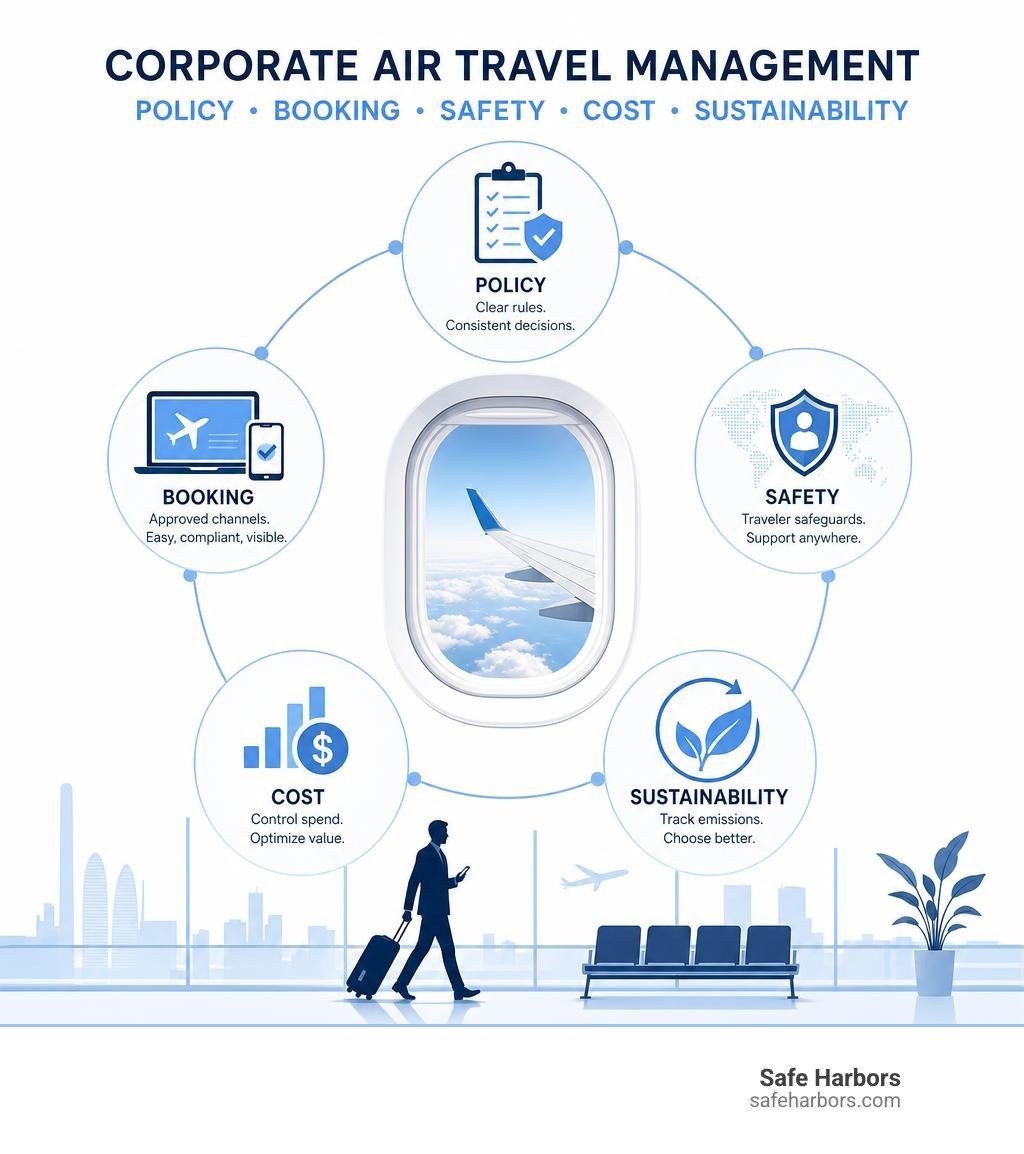
Corporate air travel management means putting the right trips, booking channels, traveler safeguards, and spending rules into one connected program. For travel managers, the practical goal is simple: make it easy for employees to book approved flights, get help fast when plans change, and stay within cost and sustainability targets.
A smart program starts with four basics:
- Set clear rules for trip approval, cabin class, and preferred airlines.
- Use one booking and support system so travelers are visible and policy-compliant.
- Track both airfare spending and flight emissions.
- Prioritize trips that need in-person time, such as client meetings, conferences, and training.
This matters more than ever. Three in four travel managers expected larger budgets in 2025, yet budget-cut expectations also rose. At the same time, sustainability commitments are restricting travel for more organizations, while conferences and learning programs continue to bring people onto the road.
The result is a tougher balancing act: control costs without making travel painful, protect employees wherever they fly, and ensure every trip supports a real business outcome.
I am Jay Ellenby, President of Safe Harbors Travel Group, with decades of experience in corporate air travel, global travel management, duty of care, and complex international logistics. In this guide, I will break down how to build a travel program that gives your team better support, stronger control, and fewer surprises.
The Evolving Landscape of Corporate Air Travel

The corporate flight landscape has entered an era defined by disciplined intentionality. Organizations are no longer traveling simply because the calendar turned; they are scrutinizing the business value of every departure. Overall incidence rates dropped from 36% in 2024 to 31% in 2025, reflecting a calculated shift toward fewer, higher-impact journeys.
Despite this contraction in routine travel, specific segments are accelerating. Live events and structured development programs represent major catalysts for executive movement. Nearly two-thirds of business travelers expect to attend a industry conference, making live gatherings the primary impetus for corporate transit. Concurrently, internal education is commanding dedicated resources: two-thirds of travel managers report expanding budgets for learning and development initiatives, up from 54% in 2024.
According to insights published in the 2025 Deloitte Corporate Travel Study | Deloitte Insights, organizations are navigating a complex commercial environment where nominal spending rises even as real trip volume stabilizes. Earlier baseline evaluations from the Corporate travel study 2023 | Deloitte Insights indicated that airfare inflation and supply constraints would force a permanent rethink of trip justification—a reality now fully realized in executive boardrooms worldwide.
Macroeconomic Pressures and Enterprise Spending Divergence
A significant divergence has emerged between enterprise organizations and mid-market businesses. While three in four travel managers report expanding budgets, the share anticipating outright budget reductions climbed from 6% to 10%. This strain is concentrated among high-spend enterprises: one in five companies with more than US$7.5 million in annual travel spend anticipate budget declines, compared to only 6% of smaller firms.
Larger corporations face acute scrutiny over operational overhead, prompting procurement teams to explore methods for optimizing business travel spend. Elevated base airfares, fuel surcharges, and premium ancillary fees require aggressive management. Mid-sized enterprises, conversely, continue leveraging agility to capture market share through client-facing touchpoints, viewing travel as an indispensable growth engine rather than a discretionary ledger entry.
Cross-Industry Benchmark Disparities in Policy Allowances
Corporate travel guidelines vary significantly across different commercial sectors. Data compiled in the Daily Briefing: Corporate Travel Policy Benchmark 2026 — Cross-Industry Comparison of Business-Class Thresholds, Per-Diem Caps, Preferred-Vendor Coverage, and T&E Pre-Approval | Business Travel Today reveals widening structural gaps between high-margin professional fields and cost-sensitive consumer industries.
| Industry Sector | Business-Class Flight Threshold | NYC Per-Diem Hotel Cap | Preferred-Vendor Coverage | T&E Pre-Approval Spend Threshold |
|---|---|---|---|---|
| Finance & Banking | 7 Hours | $625 | 92% | $3,000 |
| Professional Services | 7 Hours | $525 | 88% | $1,500 |
| Technology | 8 Hours | $475 | 84% | $1,500 |
| Energy & Utilities | 8 Hours | $450 | 80% | $3,000 |
| Healthcare & Life Sci | 9 Hours | $375 | 76% | $500 |
| Retail & Wholesale | 12 Hours | $325 | 64% | $500 |
These policy variances carry direct ramifications for talent acquisition and staff retention. Restrictive guidelines in sectors like retail can create operational friction, whereas the structured allowances in finance ensure high compliance alongside traveler satisfaction. When organizations leave policies misaligned with market conditions, rogue booking behaviors inevitably rise.
Strategic Policy Architecture and Cost Governance

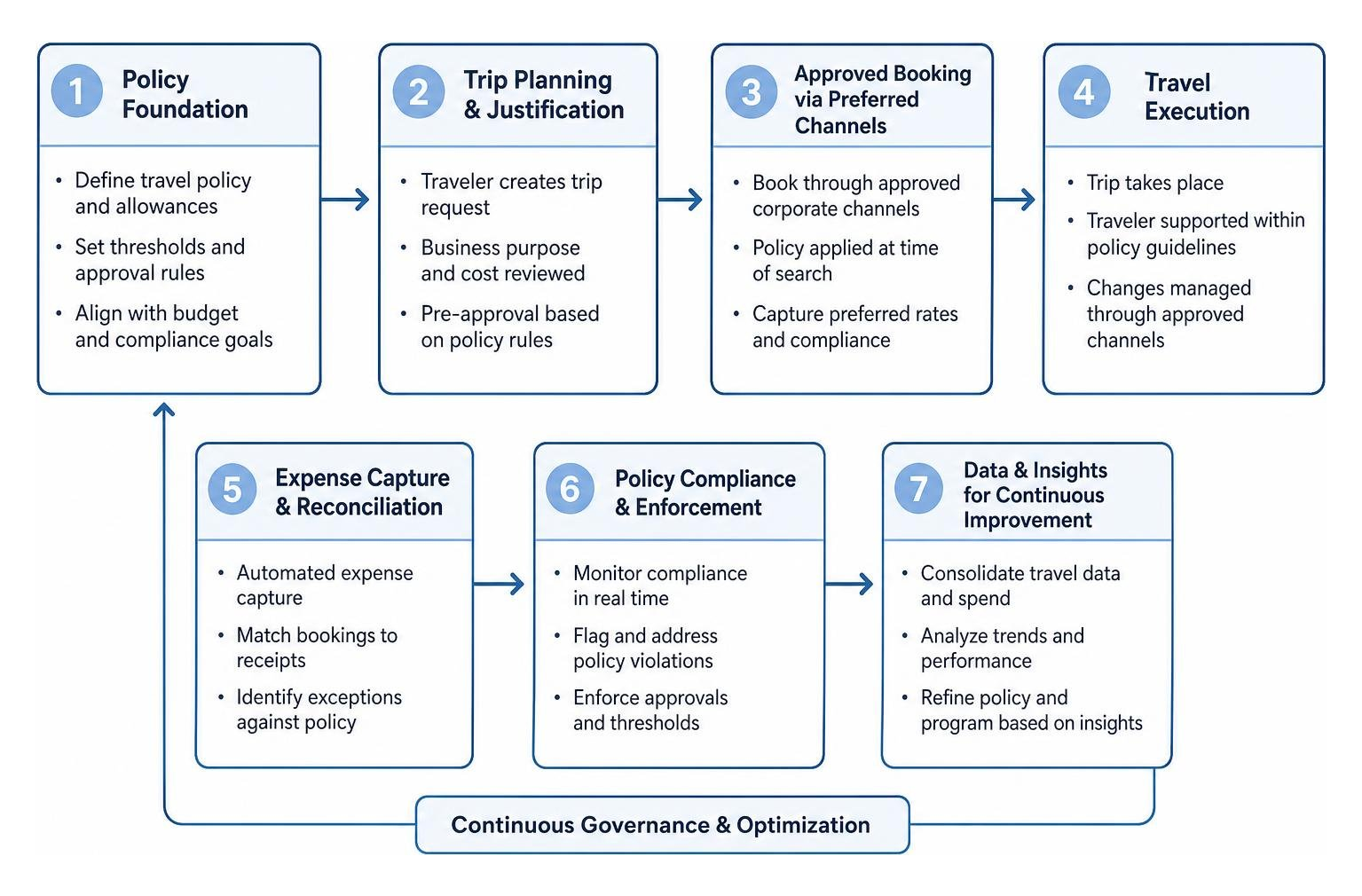
Modern travel management requires programmatic policy architecture. Operating without unified oversight leads to booking leakage, unmanaged expense variances, and gaps in employee security. Establishing structured protocols through centralized corporate travel booking channels enables businesses to capture consolidated data, automate approvals, and maintain consistent policy compliance across all business units.
Optimizing Booking Channels for Corporate Air Travel
Channel compliance serves as the bedrock of commercial air management. When travelers book independently through consumer online travel agencies, companies lose visibility and surrender valuable contract leverage. Modern travel programs counter this by deploying an intuitive corporate booking tool that mirrors consumer platforms while embedding travel guidelines, preferred supplier discounts, and pre-trip verification directly into the user workflow.
Centralized booking platforms capture negotiated volume discounts while automating real-time price tracking. Should a carrier reduce fares post-reservation, automated tools re-ticket itineraries at lower rates. This structured channel containment prevents rogue expenses, consolidates airline credits, and eliminates the hidden costs associated with manual expense reconciliation.
Cabin Eligibility, Per-Diem Caps, and Spend Approvals
Cabin entitlement parameters represent one of the largest expenditure variables in corporate mobility. The cross-industry median flight-duration threshold for premium seating sits at 8 hours. Sectors requiring immediate on-arrival productivity, such as financial advisory and management consulting, maintain 7-hour thresholds for business class air travel, allowing teams to arrive rested and client-ready.
Advanced programs also integrate return-flight differentials. Recognizing that outbound overnight flights demand sleep while daytime return legs allow for in-flight work, 38% of enterprise policies apply nuanced duration rules based on directionality and circadian impact. Paired with tiered pre-approval thresholds—ranging from $500 for strict procurement sectors to $3,000 in executive environments—organizations successfully balance commercial efficiency with employee well-being.
Sustainable Aviation and Technological Integration
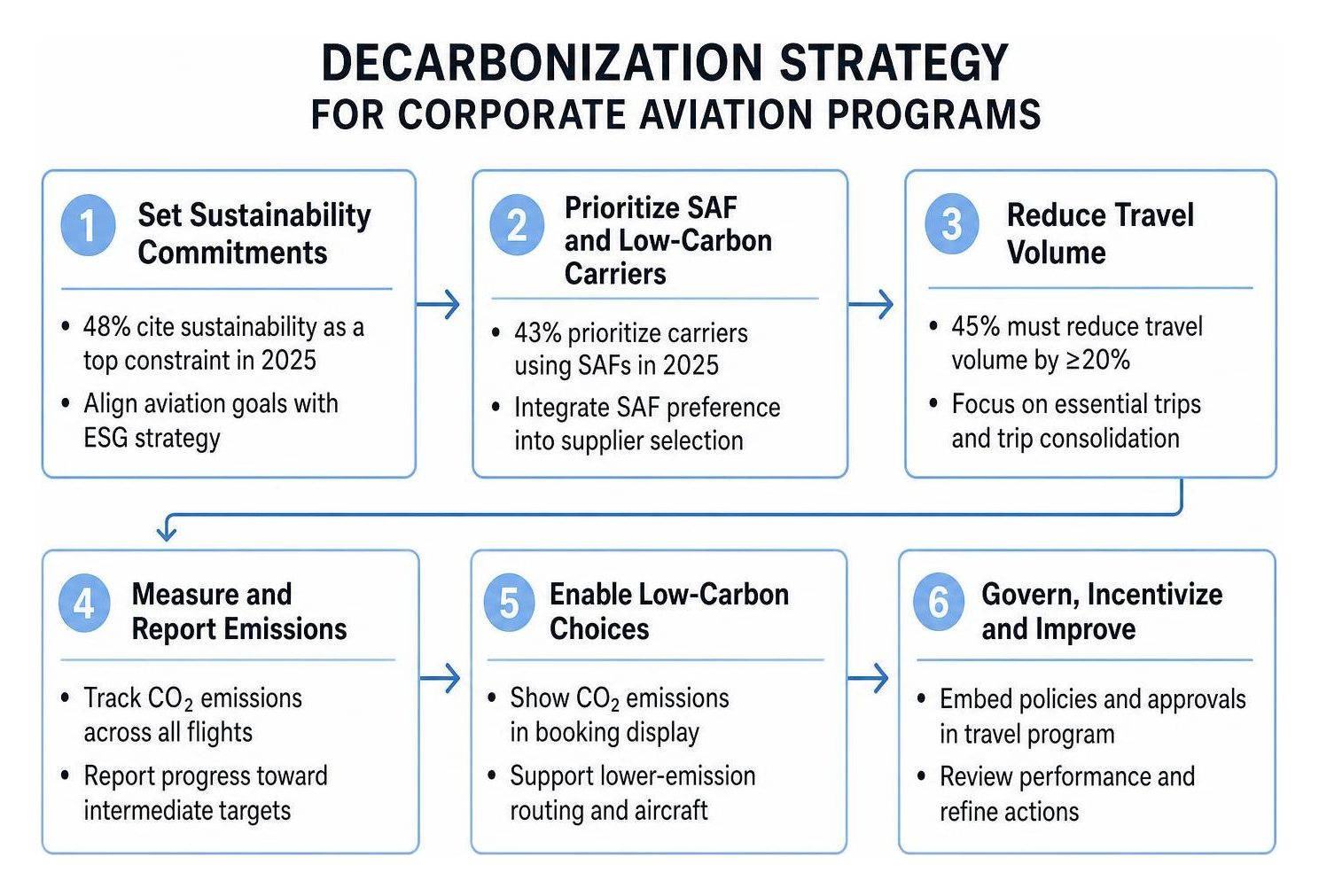
Environmental accountability has transitioned from public relations rhetoric into binding operational policy. Today, 48% of travel managers cite sustainability commitments as a top factor restricting corporate transit, up sharply from 38% in 2024. Enterprises are actively balancing corporate carbon footprints against commercial objectives through rigorous emissions measurement.
Decarbonizing Corporate Air Travel Through SAF and Governance
Corporate decarbonization is accelerating through direct procurement mandates. The share of travel buyers reporting that their organizations prioritize carriers utilizing sustainable aviation fuels (SAFs) jumped to 43% in 2025, compared to 33% in 2024. Simultaneously, 45% of enterprise buyers note their organizations must reduce overall travel volume by 20% or more to hit intermediate emissions targets, nearly doubling the 24% recorded previously.
Achieving these aggressive benchmarks requires comprehensive sustainable business travel solutions that integrate CO2 emissions data directly into the booking display. By presenting carbon footprints alongside airfare options, organizations empower employees to select optimized routing and lower-emission aircraft types, aligning daily operational choices with broad ESG governance mandates.
Digital Work Patterns, Event Consolidation, and Hybrid Travel
The permanent establishment of hybrid operational models has fundamentally altered journey composition. Routine internal status updates and administrative check-ins remain handled via enterprise video conferencing platforms. Consequently, physical travel budgets are redirected toward high-impact engagements: strategic client presentations, major supplier negotiations, cross-functional project kickoffs, and organizational training seminars.
Trip consolidation has emerged as standard operating procedure. Rather than dispatching staff on multiple short, single-purpose excursions, companies now mandate clustered itineraries. A single journey frequently combines attendance at an industry summit with localized client consultations and regional team reviews, maximizing the financial and environmental return on every booked segment.
Comprehensive Duty of Care and Risk Management
Employee protection represents an absolute legal and ethical requirement for modern organizations. Managing corporate mobility demands real-time visibility into global flight operations, geopolitical dynamics, severe weather events, and public health disruptions. Establishing clear protocols for duty of care in travel industry operations safeguards corporate personnel wherever business demands take them.
Unmanaged bookings introduce severe blind spots. If a severe disruption or international crisis occurs, travel managers utilizing fragmented booking methods cannot reliably locate or communicate with their teams. Partnering with a dedicated specialist for comprehensive travel risk management provides round-the-clock tracking, automated emergency alerts, and immediate, white-glove re-accommodation support when travel plans encounter unexpected operational hurdles.
Frequently Asked Questions
How are enterprises balancing corporate airfare inflation with carbon reduction targets?
Enterprises reconcile rising ticket prices with emissions goals by enforcing strict trip justification workflows and carbon budgeting. Organizations prioritize multi-purpose itineraries over single-meeting trips, leverage hybrid collaboration tools for internal operational updates, and direct preferred air volume toward carriers utilizing modern fleets and sustainable aviation fuels.
What flight duration threshold qualifies employees for business-class travel?
The cross-industry median threshold for premium cabin eligibility is 8 hours of continuous scheduled flight time. However, allowances vary substantially by industry: finance and management consulting establish baseline eligibility at 7 hours, technology benchmarks cluster at 8 hours, and retail organizations often require 12 hours or restrict eligibility exclusively to senior executive leadership.
How does an enterprise travel management partner improve air program compliance?
A travel management partner integrates corporate travel rules, negotiated discount programs, and multi-tier approval paths directly into a streamlined booking ecosystem. This setup eliminates off-channel leakage, guarantees access to negotiated corporate airfares, captures unused ticket credits, and delivers comprehensive reporting covering spend patterns, program compliance, and real-time duty of care tracking.
Conclusion
Managing modern corporate mobility requires striking a continuous balance between cost control, traveler well-being, and corporate responsibility. Ad-hoc booking methods expose organizations to price volatility, administrative bloat, out-of-policy spending, and unacceptable traveler safety risks. Thriving in today's complex commercial aviation landscape demands structured policy design, intelligent technology, and expert operational oversight.
At Safe Harbors, we deliver comprehensive global travel management designed around rapid response times, elite booking technology, and dedicated white-glove concierge service. Our programs help organizations navigate complex fare structures, maintain regulatory compliance, and fulfill their duty of care obligations with absolute confidence.
Discover how our strategic business travel services can transform your corporate travel program into an optimized, cost-efficient, and traveler-centric asset.