

The Hidden Costs and Operational Limits of Manual Travel Tracking

Scaling enterprises outgrow spreadsheets for travel management because manual tracking cannot control off-policy bookings, show committed spend in real time, protect travelers at scale, or keep reconciliation work manageable. An enterprise travel management platform solves these problems by centralizing bookings, approvals, policy rules, reporting, and traveler visibility in one controlled workflow.
Spreadsheets are cheap to set up, highly flexible, and accessible to everyone. In the early days of a business, tracking flight receipts and hotel confirmations in a shared workbook seems harmless. However, as an organization expands across multiple offices, time zones, and project teams, this static approach quickly becomes an administrative nightmare.
The most immediate friction point is rogue spending, often referred to as off-policy leakage or "leakage spend." When employees must interpret a static travel policy written in a PDF handbook and record their receipts manually, they frequently book consumer travel sites directly. This leads to unmanaged bookings where company rates are ignored, cancellation fees compound, and unused flight credits vanish into thin air. Finance teams end up spending dozens of hours every month manually reconciling credit card statements against fragmented receipts, chasing down missing line items, and manually correcting currency conversion mistakes.
Beyond simple billing headaches, data inaccuracy cripples strategic planning. Spreadsheets only reflect past behavior, and usually with a lag of several weeks. If senior leaders do not know what travel has been committed in real time, they cannot forecast budgets or negotiate bulk discounts with preferred airlines and hotel chains. For an exhaustive breakdown on curbing uncontrolled expenses, explore our corporate travel spend guide. Relying on manual data entry wastes valuable talent on low-value data hygiene tasks while bleeding company resources.
Core Capabilities of a Modern Enterprise Travel Management Platform
Modern corporate travel demands technology that automates administrative hurdles while giving travelers the intuitive user experience they enjoy in consumer applications. Rather than forcing employees to jump between three different airline portals, two hotel booking sites, and an internal approval email chain, a dedicated platform brings these disparate steps together.
At its foundation, an enterprise solution centralizes global inventory, combining Global Distribution Systems (GDS), direct airline integrations (NDC), and discounted corporate hotel aggregators into a single screen. This broad access ensures that employees find competitive rates without scouring third-party consumer tools. At the same time, automated pre-trip approvals route itinerary requests to the correct department head based on dynamic parameters such as trip cost, destination risk, or advance purchase timing. Equipping your workforce with a modern corporate online booking tool transforms booking from a disjointed chore into a seamless, controlled self-service experience.
| Operational Area | Manual Spreadsheet Tracking | Modern Booking Software |
|---|---|---|
| Inventory Access | Fragmented consumer sites with unnegotiated rates | Centralized global inventory with corporate discounts |
| Policy Enforcement | Passive, post-trip review via expense reports | Dynamic, real-time prompts during search and checkout |
| Approval Process | Manual email chains and retrospective validation | Automated, rule-based workflows routed in seconds |
| Duty of Care | Static cell phone numbers and manual check-ins | Live itinerary tracking and instant emergency alerts |
| Spend Visibility | Delayed by weeks; prone to formula and human errors | Real-time interactive dashboards and predictive analytics |
How an Enterprise Travel Management Platform Enforces Policy Compliance
Dynamic policy automation is where dedicated travel software truly shines. Rather than relying on employees to memorize complex rate caps, modern software embeds travel rules directly into the search interface. When an employee searches for a flight from Chicago to London, the platform highlights preferred carriers, applies pre-negotiated corporate rates, and filters out flights that exceed company budget limits.
If an itinerary falls outside standard parameters—such as booking business class on a domestic flight or selecting a non-refundable room rate without justification—the system flags the violation before purchase. It can either prompt the traveler to select a compliant alternative or automatically trigger an escalated approval request to their manager. By delivering proactive guardrails rather than retroactive penalties, our enterprise travel solutions ensure compliance rates soar while eliminating unpleasant surprises for the finance department.
Enterprise System Integrations and Data Analytics
A travel platform should never exist in a software silo. To maximize its impact, the system must interface directly with your core enterprise ecosystem, including your Enterprise Resource Planning (ERP), Human Resources Information System (HRIS), and expense management applications.
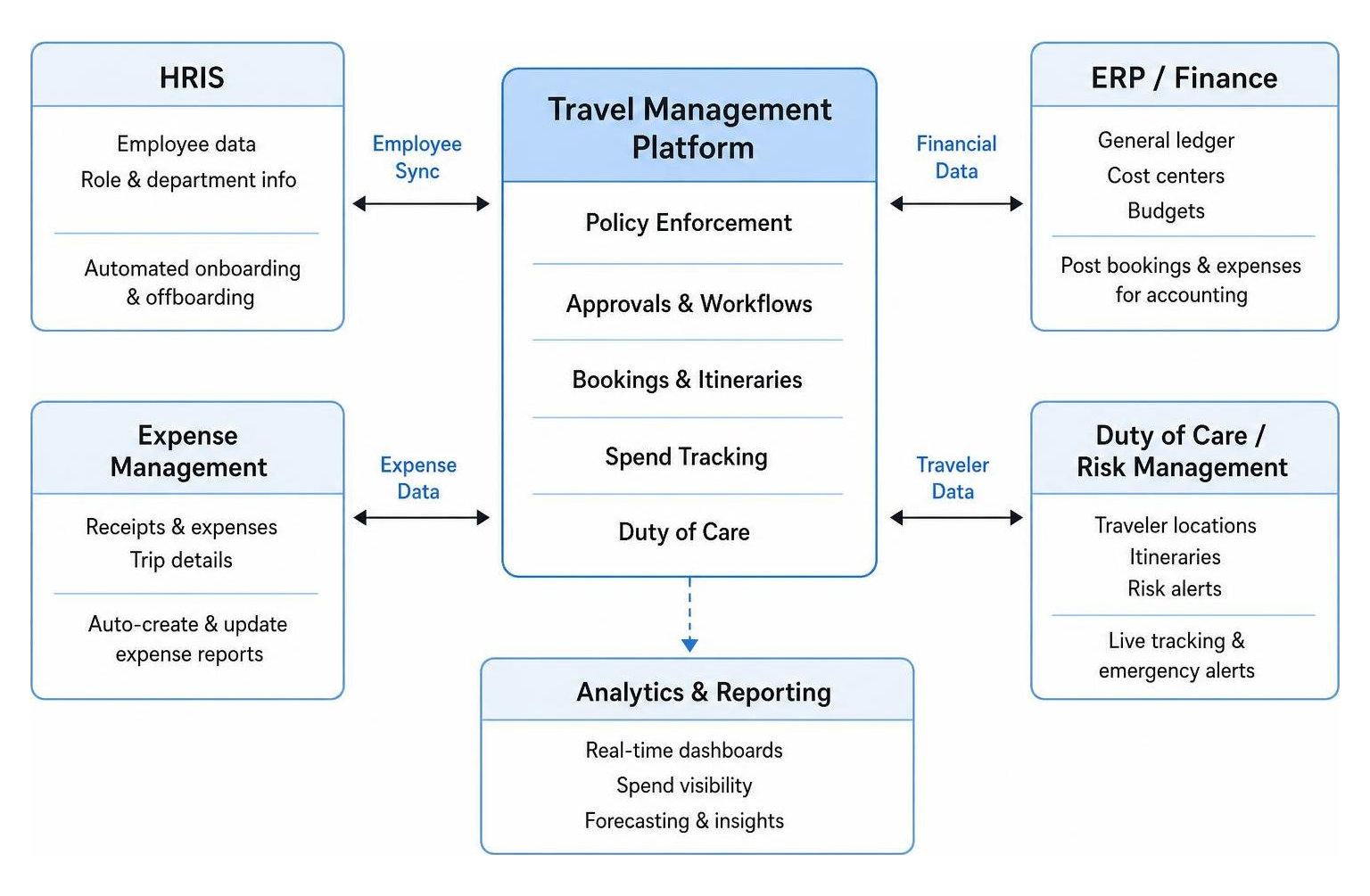
When an HRIS integrates with your travel setup, employee onboarding and offboarding occur automatically. When a team member changes departments or leaves the organization, their travel permissions, spending limits, and approval routing update instantly. Similarly, bidirectional expense integrations automatically feed trip receipts into expense reports, eliminating manual data entry for traveling staff. By connecting these systems through robust corporate travel technology, enterprise leaders gain end-to-end visibility into overall travel investment, project-level expenditures, and departmental ROI.
Mitigating Risk and Ensuring Duty of Care at Scale
Legal and moral obligations require organizations to take proactive measures to ensure the safety and well-being of their traveling personnel. Fulfilling duty of care is nearly impossible when your travel program relies on static spreadsheets, calendar invites, and fragmented email confirmations.
When geopolitical crises, severe weather events, or transportation strikes occur, safety teams need immediate answers. They cannot spend hours calling hotels or combing through credit card receipts to determine if an employee is in a storm zone. Modern platforms provide interactive traveler-tracking maps that aggregate itinerary data, hotel bookings, and real-time flight telemetry.

In an emergency, travel managers can pinpoint an employee's exact location, broadcast instant safety notifications via SMS or in-app alerts, and initiate direct evacuation or medical assistance protocols. To gain a deeper understanding of legal requirements and corporate liability, read our guide to duty of care business travel. Coupling robust software tracking with our dedicated travel risk management services provides total peace of mind for both corporate leaders and team members on the road.
Framework for Evaluating Corporate Travel Technology
Selecting travel software requires balancing user-friendly design with deep administrative control. When evaluating potential platforms, companies should look beyond flashy consumer-like interfaces and systematically evaluate how the software handles complex corporate workflows, international itineraries, and long-term business goals.
Key criteria should include the depth of supplier content, omnichannel accessibility across mobile and desktop, flexible approval hierarchies, and integration breadth. A modern platform must adapt smoothly as your footprint expands across new global regions and regulatory environments. Partnering with a specialist in global travel management ensures your chosen software is supported by the commercial agreements, localized currencies, and supplier partnerships necessary to scale effectively.
Selecting the Right Enterprise Travel Management Platform for Global Scale
When evaluating prospective tools for an international enterprise, prioritize features that accommodate distributed, modern workforces:
- Omnichannel Access: Travelers should be able to search, book, modify, and receive disruption alerts smoothly across mobile apps, desktop browsers, and collaborative messaging tools.
- AI-Powered Personalization: Intelligent engines learn individual traveler preferences—such as favorite seating rows, hotel amenities, and frequent flyer numbers—without violating overarching company policy.
- Sustainability and Carbon Tracking: Built-in carbon accounting tools display emissions estimates alongside flight options, helping organizations monitor and meet ESG targets.
- 24/7 Human-Led Support: Self-service tools are fantastic until a blizzard cancels three connecting flights. Elite platforms back up digital booking with rapid, human concierge support.
Transitioning from Legacy Travel Agencies Without Disruption
Migrating an organization from a legacy offline travel agency or an unruly collection of spreadsheets to a modern platform can feel intimidating. Without thoughtful change management, employees may resist the new tool and continue booking through unauthorized channels.
Successful transitions rely on clear internal communication, practical department-level training sessions, and seamless data migration of traveler profiles and loyalty numbers. When you partner with an experienced travel management company, you receive white-glove onboarding and continuous change management support. We help streamline technical integrations and internal workflows so your team hits the ground running without operational friction.
Frequently Asked Questions About Corporate Travel Software
How quickly do enterprises see ROI after adopting dedicated travel software?
Most enterprises achieve measurable return on investment within the first six to twelve months of adoption. Organizations that automate their travel programs frequently capture up to a 30% reduction in travel costs during their first year. These savings stem from dynamic policy enforcement, access to negotiated corporate rates, recovery of unused flight credits, and an average savings of 45 minutes of booking time per trip for employees.
How do enterprise booking tools handle complex multi-leg global itineraries?
Enterprise booking platforms use advanced multi-carrier itinerary builders that combine inventory across distinct airline alliances and regional rail operators into a single unified checkout. The software calculates foreign exchange rates automatically, verifies necessary transit documentation or visa prerequisites, and routes the full itinerary through customized approval tiers. If an itinerary is exceptionally intricate, platforms paired with white-glove concierge services allow travelers to hand off multi-leg logistics to dedicated travel counselors with a single click.
Can travel management software integrate directly with existing ERP and HR systems?
Yes. Modern platforms provide open APIs and native connectors that link directly with leading ERP platforms, HRIS databases, and expense tools. This enables automatic employee profile provisioning, continuous budget tracking against specific general ledger accounts, and instant, bi-directional receipt synchronization that simplifies month-end financial reconciliation.
Conclusion
Scaling an enterprise requires modernizing every core business function, and corporate travel is no exception. Continuing to manage flight bookings, policy compliance, expense reconciliation, and traveler safety through disconnected spreadsheets and email chains drains administrative productivity and introduces severe duty-of-care vulnerabilities.
By adopting a centralized enterprise travel platform backed by experienced travel professionals, your organization gains actionable financial visibility, automated policy adherence, and 24/7 protection for your mobile workforce. At Safe Harbors, we unite cutting-edge technology partnerships with lightning-fast response times and white-glove concierge management. Explore our comprehensive business travel services today to elevate your corporate travel program.