
Annual Travel Medical Insurance: Your Guide to Year-Round Protection

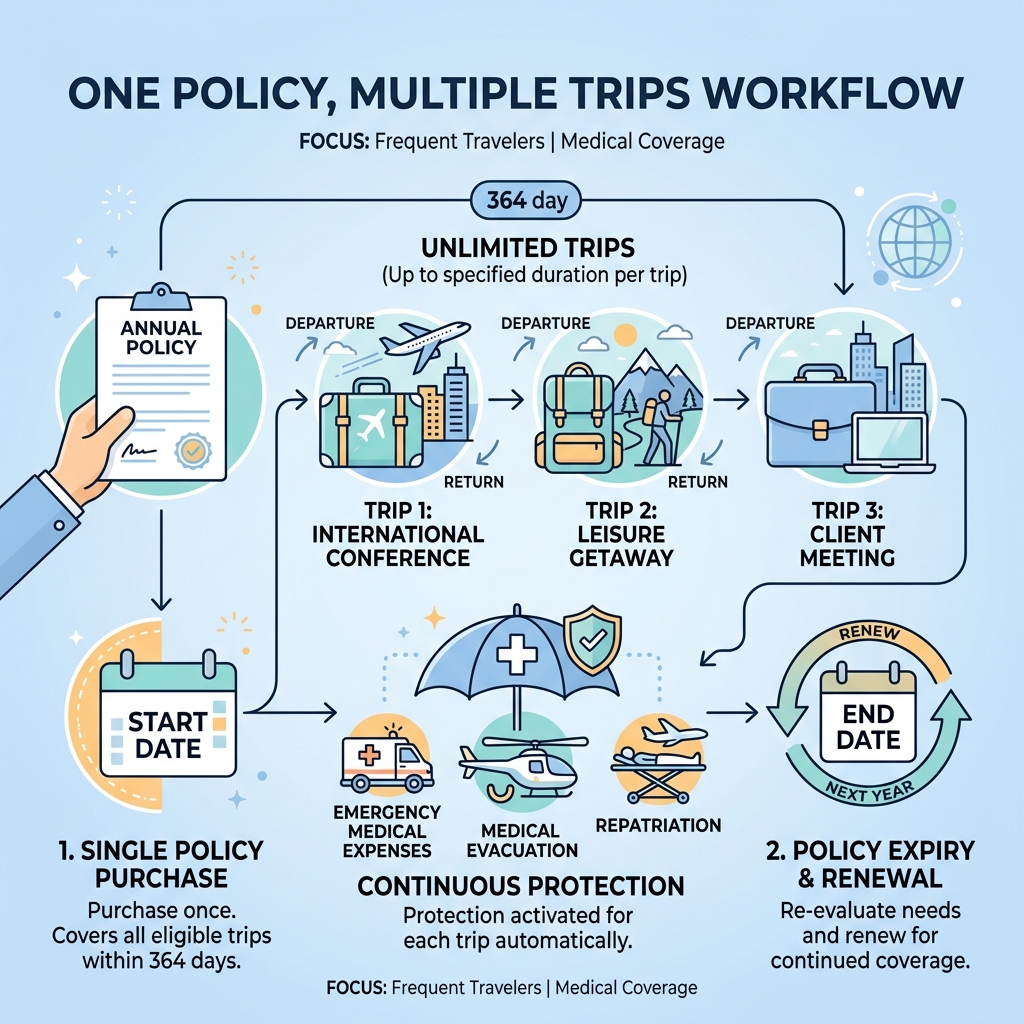
Annual travel medical insurance is a single policy designed to cover all your eligible trips within a 12-month period. It's a smart solution for frequent travelers seeking continuous protection.
- Covers multiple trips: Provides protection for unlimited journeys over 364 days.
- Medical focus: Primarily offers emergency medical expenses, medical evacuation, and repatriation.
- Cost-effective: Often cheaper than buying individual policies if you travel 3+ times a year.
- Convenient: Eliminates the need to purchase insurance before each trip, saving time and hassle.
- Peace of mind: Ensures continuous health and travel protection for frequent travelers.
Imagine managing global business travel, ensuring every employee is safe, every trip smooth. The thought of buying separate medical insurance for each journey can be a real headache. That's where annual travel medical insurance steps in. It's a game-changer for frequent travelers, simplifying protection and bringing peace of mind. Instead of repeat purchases, you get continuous, year-round coverage. This guide will show you why it's a smart move for your company and your travelers.
As President of Safe Harbors Travel Group, Jay Ellenby has leveraged decades of deep travel industry expertise to build a nationally recognized leader in full-service global travel management. His extensive knowledge, particularly in risk management and duty of care, ensures that Safe Harbors clients receive intelligent travel solutions, including optimal annual travel medical insurance strategies.
What is Annual Travel Medical Insurance and How Does It Work?
If you are a frequent flyer, a digital nomad, or a business professional who lives out of a suitcase, you know the drill: book the flight, book the hotel, and-if you’re responsible-buy the travel insurance. Doing this ten times a year isn't just tedious; it’s inefficient.
Annual travel medical insurance (also known as multi-trip insurance) is a policy that covers you for an unlimited number of trips taken within a 364-day period. Unlike a single-trip policy that expires the moment you return home, an annual plan stays active in the background, ready for your next departure.

Key Mechanics of Annual Plans
To understand how these plans work, we need to look at a few "rules of the road":
- The 364-Day Period: Most policies cover you for one day shy of a full year to avoid renewal overlaps.
- The 100-Mile Rule: For a trip to be "covered," you typically need to be at least 100 miles away from your primary residence. This prevents people from trying to use travel insurance for a trip to the local pharmacy.
- Trip Duration Limits: While you can take unlimited trips, each individual trip usually has a "cap." Common limits are 30, 45, 70, or 90 days. If you plan to stay in one country for six months straight, you might need a "Nomad" or long-term expat plan instead of a standard annual multi-trip policy.
- Automatic Protection: You don't need to notify the insurer every time you leave. As long as the trip falls within the policy dates and meets the distance requirements, you’re covered.
Single-Trip vs. Annual Multi-Trip Insurance
| Feature | Single-Trip Insurance | Annual Travel Medical Insurance |
|---|---|---|
| Duration | Specific dates of one trip | 364 days |
| Trip Count | One | Unlimited |
| Medical Focus | High (often includes cancellation) | Very High (primary focus) |
| Cost | Varies by trip cost/length | Fixed annual premium |
| Best For | Once-a-year vacationers | Frequent/Business travelers |
For those looking to dive deeper into the top-rated providers for the upcoming years, you can check out the Best Annual Travel Insurance Companies for 2026 to see how different plans stack up.
Comprehensive Coverage for Annual Travel Medical Insurance
The "medical" in annual travel medical insurance is the most critical part. Many travelers assume their domestic health insurance or Medicare will follow them across borders. In reality, Medicare rarely provides coverage outside the U.S., and many employer-sponsored plans operate on a "pay-and-claim" basis, meaning you have to cover costs upfront and seek reimbursement later.
A robust annual plan typically includes:
- Emergency Medical Expenses: Coverage for accidents or sudden illnesses, including hospital stays and surgery. Limits can reach up to $1,000,000.
- Medical Evacuation: If you’re in a remote area without adequate facilities, this covers the cost of getting you to a high-quality hospital-often a six-figure expense.
- Outpatient Care: Doctor visits, prescriptions, and lab tests.
- Repatriation of Remains: A somber but necessary coverage for transporting a traveler back home in the event of a fatality.
- COVID-19 Protection: Most modern plans treat COVID-19 like any other respiratory illness, covering medically necessary treatment.
To keep your travelers in top shape between those covered events, check out our 10 Tips for Staying Healthy During Frequent Business Travels.
Geographic Scope and Domestic vs. International Rules
Annual plans offer incredible flexibility, but you must choose your geographic "zone." Usually, you’ll choose between "Worldwide" or "Worldwide Excluding the U.S." If you are a U.S. resident, your domestic health insurance handles you at home, so you might choose the "Excluding U.S." option to save on premiums.
However, many frequent business travelers opt for worldwide coverage because it fills the gaps in domestic plans, such as emergency medical evacuation or high deductibles. It’s also important to note that most plans exclude "Home Country" coverage; the insurance is meant to protect you while you are traveling, not while you are sitting in your living room.
Is Annual Coverage Right for Your Travel Habits?
We often tell our clients that the "magic number" for annual travel medical insurance is three. If you take three or more international trips per year, the annual policy almost always pays for itself in both dollars and hours saved.
Roughly 30% of travelers take three or more international trips per year, making this a highly practical choice for a significant portion of the workforce. It's not just about the cost, though-it's about the "spontaneity factor." When a last-minute meeting pops up in London or Singapore, you don't want to be stuck on a website entering passport details and credit card numbers for a one-off policy.
To see how the numbers work for your specific age and destinations, you can Compare Annual Travel Insurance: Plans & Prices (2026) and see real-world data on what other frequent flyers are paying.
Why Business Professionals Choose Annual Travel Medical Insurance
For organizations, annual plans are a cornerstone of Corporate Duty of Care. As an employer, we have a legal and moral obligation to ensure our team members are protected while they represent our company abroad.
- Risk Mitigation: Knowing every employee is covered the moment they cross the 100-mile mark reduces corporate liability.
- Administrative Ease: One renewal per year instead of dozens of individual expense reports for insurance line items.
- Duty of Care Compliance: It ensures that no traveler "forgets" to buy insurance for a quick two-day trip, which is often when the most unexpected accidents happen.
Cost Factors and Premium Drivers
How much does it actually cost to stop buying insurance every time you fly? On average, travelers spend about $397 on an annual policy. When you break that down, it's less than $1.10 per day for year-round protection.
Several factors will influence your specific quote:
- Age: Premiums for travelers under 35 can be as low as $80-$100, while seniors may see higher rates due to increased medical risk.
- Coverage Limits: A plan with a $1,000,000 limit will cost more than one capped at $50,000.
- Deductibles: You can often lower your premium by choosing a higher deductible (e.g., $250 per trip).
- Add-ons: Including trip cancellation or hazardous sports coverage will increase the price.
If you want help evaluating annual coverage as part of a managed business travel program, learn more about Safe Harbors' Global Travel Management services for frequent business travelers.
Common Limitations and Policy Exclusions
No insurance policy is a "catch-all," and annual travel medical insurance has specific boundaries you need to respect.
The "Big Three" Exclusions
- Pre-existing Conditions: Most annual plans exclude chronic conditions you had before the policy started. However, many offer coverage for the "Acute Onset" of a pre-existing condition—meaning a sudden, unexpected recurrence that requires emergency care within 24 hours.
- Maximum Trip Length: We mentioned this earlier, but it bears repeating. If your policy has a 30-day limit and you get sick on day 35 of a long trip, you likely won't be covered. Always match your policy limit to your longest expected journey.
- High-Risk Activities: If your business trip to Switzerland includes a weekend of "extreme" heli-skiing or paragliding, you may need a specific "Hazardous Activity" rider. Standard policies usually cover recreational sports like hiking or swimming but draw the line at professional athletics or high-adrenaline stunts.
Managing these nuances is a key part of Travel Risk Management. We recommend all our clients review the "Description of Coverage" to ensure their specific activities aren't on the excluded list.
Frequently Asked Questions about Multi-Trip Coverage
Does annual travel insurance cover trip cancellations?
This is a common point of confusion. Most annual travel medical insurance plans focus primarily on medical emergencies. While they often include small benefits for trip interruption or lost baggage, they may not cover the full cost of a $10,000 cancelled cruise.
However, some premium annual plans allow you to add a "Trip Cancellation" rider, often capped at around $2,500 to $10,000 for the entire year. If you are booking very expensive, non-refundable trips, you should verify if your annual plan includes this or if you need a separate comprehensive policy for that specific journey.
Can I add family members to my annual plan?
Yes! Many providers allow you to purchase a family plan. This is often more cost-effective than buying individual policies for a spouse and children. Generally, the "primary insured" must be present, or the family members must meet specific eligibility requirements. It’s a great way to ensure the whole family is protected during summer vacations and school breaks without any extra paperwork.
How does the 100-mile rule affect domestic travel?
The 100-mile rule is designed to distinguish "travel" from "daily life." If you live in Philadelphia and take a train to New York City (roughly 95 miles), your travel insurance might not kick in. But if you fly to Chicago, you are well beyond the threshold. This is particularly useful for domestic travelers because while your health insurance might work in another state, it likely won't provide "Travel Assistance Services" like helping you find a local specialist or arranging a medical flight back to your home hospital.
Conclusion
At the end of the day, annual travel medical insurance is about reclaiming your time and securing your finances. It transforms insurance from a "to-do list" item into a background safety net. Whether you are a solo entrepreneur or managing a global team, the convenience of year-round protection is hard to beat.
At Safe Harbors, we specialize in these types of global business travel solutions. We believe in a "white-glove" approach, where our unmatched response speed and concierge management ensure that your travelers are never left navigating a medical crisis alone. From duty of care compliance to finding the most cost-effective annual plans, we are here to reimagining your travel ecosystem.
Ready to simplify your travel program? Learn more about our Global Travel Management services and how we can help you stop buying insurance every time you fly. Safe travels!