

Understanding Your Legal and Ethical Obligation to Employees

Corporate duty of care is an organization's legal and moral obligation to protect employees from foreseeable harm. It requires taking reasonable steps to ensure their health, safety, and well-being—whether they're working in an office, remotely, or traveling for business.
Quick Answer: What You Need to Know About Corporate Duty of Care
- Definition: A legal and ethical obligation to take reasonable care to prevent foreseeable harm to employees.
- Responsibility: Employers must promote employee health, safety, and well-being wherever they work.
- Scope: Applies to workplace safety, business travel, health, and mental well-being.
- Accountability: Responsibility is shared across leadership, HR, and travel management teams.
- Modern Approach: Extends beyond compliance to include proactive risk management and crisis response.
The world is increasingly unpredictable, and in over 50 countries, duty of care laws now cover business travelers. The COVID-19 pandemic revealed that many businesses were unprepared, leaving employees at risk during crises. As global business travel resumes, the question is no longer if you have a duty of care, but how effectively you're fulfilling it.
I'm Jay Ellenby, President of Safe Harbors Travel Group. For decades, I've helped organizations steer the complexities of global travel and corporate duty of care. By using strategic risk management and innovative technology, I've guided companies in building frameworks that protect their traveling employees and strengthen business resilience.
The Legal and Ethical Framework of Corporate Responsibility
At its core, corporate duty of care is a fundamental principle rooted in both legal doctrine and ethical imperatives. It dictates that companies must act responsibly to prevent foreseeable harm. This responsibility extends through every level of an organization, from daily operations to strategic board decisions.

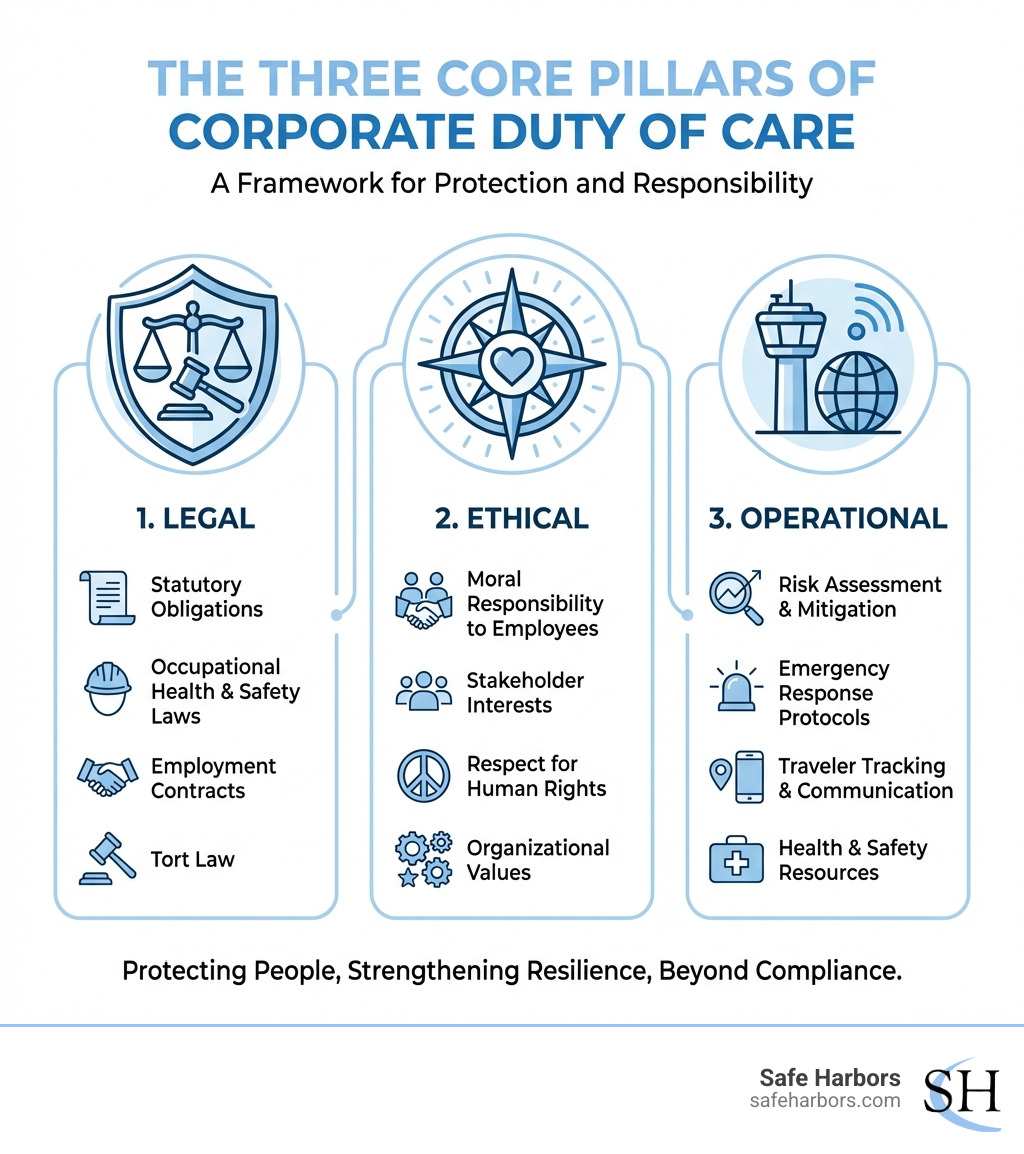
Legal and Ethical Obligations: The Twin Pillars
Legally, a duty of care requires a standard of reasonable care to avoid acts that could foreseeably harm others. This concept is central to tort law, where a failure to uphold this duty can lead to a finding of negligence. In the corporate world, this means a company has a legal and moral obligation to protect its employees from undue risks, whether in the office or traveling for business. Breaching this duty can result in lawsuits, fines, and reputational damage. For a deeper dive, you can explore resources like What is the "Duty of Care" in Personal Injury Law?.
Ethically, this duty is about prioritizing the well-being of employees and other stakeholders. It compels businesses to act with integrity and consider the broader impact of their actions, including respecting human rights as outlined in frameworks like the UN Guiding Principles on Business and Human Rights. This commitment builds a trustworthy and reputable organization. To learn more about meeting these standards, read our guide on Duty of Care Compliance.
The Director's Balancing Act: Duty of Care vs. Duty of Loyalty
For corporate directors, two key fiduciary responsibilities are the duty of care and the duty of loyalty. Both require directors to act in the corporation's best interests.
The duty of care requires directors to be diligent and informed when making decisions, acting as a reasonably prudent person would. The duty of loyalty demands they act in good faith, prioritizing the corporation's interests over their own and avoiding conflicts of interest.
Here's a quick comparison:
| Feature | Duty of Care | Duty of Loyalty |
|---|---|---|
| Primary Focus | Prudent decision-making, diligence, skill, being informed | Acting in the corporation's best interest, avoiding conflicts of interest, good faith |
| Standard | Reasonably prudent person in comparable circumstances | Honesty, integrity, avoiding self-interest |
| Examples | Conducting due diligence, attending meetings, seeking expert advice | Not competing with the corporation, not using corporate assets for personal gain |
| Breach Often | Negligence, lack of oversight, uninformed decisions | Self-dealing, usurpation of corporate opportunity, undisclosed conflicts |
The Business Judgment Rule generally protects directors from liability for business decisions made in good faith and on an informed basis, even if the outcomes are poor. However, this protection is not absolute. Directors and officers can still face personal liability for breaching their duties. To mitigate these risks, companies often implement a robust Risk Mitigation Strategy and carry Director and Officer (D&O) liability insurance.
Key Laws and Regulations Underpinning Duty of Care
The concept of corporate duty of care is grounded in various laws and international standards. While specifics vary by jurisdiction, the core obligations are widely recognized.
- Occupational Health and Safety (OHS) laws mandate that employers provide a safe work environment by identifying and mitigating hazards.
- Common law establishes a broad duty for organizations to exercise reasonable care to avoid harming others in many legal systems.
- Employment contracts often detail an employer's responsibilities regarding workplace safety and employee well-being.
- International standards like ISO 31030 provide a framework for managing travel risks, ensuring a consistent approach to employee safety across borders.
- The United Nations Guiding Principles on Business and Human Rights set a global standard for responsible business conduct, emphasizing the corporate responsibility to respect human rights. The OECD also provides due diligence guidance for responsible business conduct.
The Expanding Scope of Corporate Duty of Care in Business Travel
As businesses become increasingly global, the traditional boundaries of corporate duty of care expand far beyond the office walls. For companies with a mobile workforce, ensuring the safety and well-being of employees on business trips is not just good practice—it's an absolute necessity.

Applying Corporate Duty of Care to a Mobile Workforce
For employees traveling for business, their safety is the paramount concern. This transforms corporate duty of care into a dynamic, proactive process.
Pre-trip Risk Assessments: Before any journey, we evaluate the destination for potential hazards like geopolitical instability, crime, health risks, and natural disasters. This empowers travelers with essential information and allows for preventative measures.
Real-time Monitoring: While employees are traveling, we use technology to track their locations based on itineraries. This allows us to quickly identify anyone who might be near a developing crisis and confirm their safety.
Emergency Support: A robust duty of care program includes 24/7 emergency response. This means providing immediate assistance for medical issues, security threats, or travel disruptions, connecting employees to expert help when they need it most. This support is integral to our Global Travel Assistance services.
Medical Assistance: We ensure travelers have access to appropriate medical advice, facilities, and, if necessary, emergency evacuation. This includes pre-travel advice on vaccinations and access to telemedicine resources.
Communication Protocols: Clear and timely communication is vital. We establish channels to keep employees informed of evolving situations, provide critical travel advisories, and confirm their safety during incidents.
These integrated efforts are essential for comprehensive Business Travel Duty of Care and Risk Management, ensuring employees are safe and supported, no matter where their work takes them.
Tailoring Your Approach for Diverse Risks and Global Operations
A one-size-fits-all approach to corporate duty of care is ineffective. The program must adapt to the specific risks of each location and traveler. For example, a CEO traveling to a conference in Switzerland faces different challenges than an engineer on assignment in a high-risk region. Our duty of care must be customized to these individual circumstances by considering:
- Geopolitical Instability: Monitoring political unrest, civil conflicts, and terrorism threats.
- Natural Disasters: Preparing for risks like earthquakes or typhoons, which are often seasonal.
- Health Crises: Staying vigilant about regional epidemics and ensuring access to quality medical care.
- Cultural Nuances: Understanding local customs and laws to help travelers steer unfamiliar environments safely.
- High-Risk Destinations: Implementing improved security protocols and specialized training for travel to areas with liftd risks, such as those for Humanitarian Travel.
By tailoring the approach, we ensure every employee receives the appropriate level of protection. This is a core tenet of our Global Travel Management Guide 2025.
How Global Events Reshaped the Duty of Care Landscape
Recent global events have underscored that risks are dynamic and interconnected, demanding a more adaptive approach to corporate duty of care.
The COVID-19 pandemic fundamentally reshaped our understanding of this responsibility. It highlighted the need for solutions that address universal health concerns, not just location-based risks. Many businesses struggled to locate employees and steer border closures, revealing gaps in their crisis response platforms. This experience proved that a proactive strategy is no longer optional.
This increased interconnectedness means a crisis in one part of the world can quickly impact personnel globally. Furthermore, employees now have evolving expectations, looking for support that includes mental well-being, not just physical safety.
These shifts underscore why a robust travel risk plan is a continuously evolving necessity. You can read more in our article Why Implementing a Travel Risk Plan for Employees is Crucial. The lesson is clear: corporate duty of care is a dynamic, strategic imperative that must adapt to a constantly changing world.
Building a Robust and Actionable Duty of Care Program
A truly effective corporate duty of care program moves beyond intention; it requires a clear framework, defined responsibilities, and the right tools to translate commitment into action. Building such a program is an investment in your people and business resilience, creating a system that ensures every employee feels safe and supported.
The Key Components of a Comprehensive Framework
A robust corporate duty of care framework relies on several interdependent components:
A clear and accessible Travel Policy: This foundational document outlines protocols, expectations, and available resources for all business travel. It must be easily accessible and regularly communicated. Learn more from our insights on Travel Policy.
Proactive Risk Assessment and Mitigation: This involves continuously identifying potential hazards, conducting pre-trip risk assessments, and implementing strategies to reduce those risks through threat monitoring and actionable intelligence.
Comprehensive Training and Communication: Empowering employees with pre-trip preparation, destination-specific safety briefings, and real-time updates ensures they are informed and prepared before, during, and after their trips.
24/7 Emergency Response and Support: When incidents occur, a dedicated 24/7 operations center and established protocols ensure immediate response to medical, security, or travel emergencies. This is a cornerstone of effective Travel Risk Management.
Post-trip Debriefing and Program Review: Learning from experience is vital. Post-trip debriefings and regular program reviews help identify areas for improvement, adapt to new risks, and refine strategies.
By integrating these components, you create a comprehensive duty of care program that proactively protects employees and strengthens organizational resilience.
Who is Responsible? Establishing a Collaborative Structure
Fulfilling corporate duty of care is a collective effort, not the job of a single department. An effective program requires a collaborative structure. Leadership must provide buy-in and resources. Human Resources develops and communicates policies related to employee welfare. Travel Managers oversee logistics and policy implementation. Legal and Compliance teams ensure adherence to regulations, while Security officers manage threat intelligence and risk assessments. Even Finance Executives play a role in budgeting for these crucial programs. This collaborative approach embeds duty of care into the organization's culture.
Leveraging Technology and Data for Proactive Protection
In today's interconnected world, managing corporate duty of care requires smart, technological solutions to move from reactive crisis management to proactive protection.
Traveler Tracking Software: Knowing employee locations based on itineraries is fundamental for safety. This allows for immediate awareness and communication during an emergency. This capability is a key part of The Compelling Security Benefits of Corporate Travel Management.
Real-time Alerts: Systems that integrate with global alert services provide real-time threat intelligence on weather, security, or health events. These alerts are automatically sent to affected travelers and management.
Data Consolidation: To counter fragmented booking data, we consolidate information from multiple sources (booking, expense, credit card) into a unified view. This ensures accurate, up-to-date traveler information for risk assessment and response.
Mobile Apps: Dedicated mobile apps empower travelers with direct access to travel details, emergency contacts, local alerts, and a direct line to a 24/7 operations center, sometimes including "proof of life" safety check-in features.
Expert Partnerships: We partner with specialized health and risk management services, like Crisis24, to improve our capabilities. These experts provide global alerts, threat monitoring, and access to medical and security assistance worldwide, ensuring a best-in-class Immediate Response.
The Strategic Advantage: Benefits, Challenges, and Future Trends
Moving beyond basic compliance, a world-class corporate duty of care program is a strategic investment that yields significant returns. It reflects an organization's values, strengthens its foundation, and positions it for long-term success. However, it also comes with challenges and is constantly evolving to meet new global realities.
The Benefits of a World-Class Duty of Care Program
Investing in a robust corporate duty of care program delivers benefits that ripple throughout the organization:
Improved Employee Well-being and Morale: When employees feel their company genuinely cares for their physical and mental safety, morale and engagement improve significantly.
Increased Productivity: Confident in their safety, employees can focus on their work without worrying about potential risks, which boosts productivity.
Improved Retention and Recruitment: A strong commitment to duty of care builds trust and loyalty, improving retention and attracting top talent who value a responsible and caring culture.
Stronger Corporate Reputation: Companies known for ethical conduct and proactive risk management enjoy an improved reputation among customers, partners, and investors.
Improved Business Continuity: By predicting risks and responding quickly to crises, a duty of care program minimizes operational disruptions, ensuring business resilience.
Mitigated Legal and Financial Risks: A proactive program helps avoid costly lawsuits, fines, and reputational damage that can result from failing to protect employees. This is a key way to Optimize Business Travel Spend by preventing costly incidents.
A world-class program transforms a legal obligation into a strategic advantage, fostering a resilient workforce and a high-performing organization.
Navigating Challenges and Emerging Trends
The landscape of corporate duty of care is dynamic. Staying effective means navigating challenges and embracing emerging trends.
A key trend is the heightened focus on mental health support, recognizing the responsibility to address the psychological well-being of employees, especially frequent travelers. ESG (Environmental, Social, and Governance) considerations are also becoming integral, integrating human rights and ethical conduct into corporate decision-making.
Digital-age challenges include ensuring data privacy when using traveler tracking tools and managing cybersecurity risks to protect sensitive employee data. Additionally, fragmented booking behaviors, where employees use unapproved platforms, make it difficult to maintain oversight and provide support during emergencies. This highlights the need for clear policies, as detailed in articles like 7 Signs Your Employees Aren't Buying Into Your Travel Policies.
Addressing these challenges requires continuous adaptation, investment in technology, and a holistic commitment to employee well-being.
Conclusion: Making Duty of Care Your Competitive Edge
Corporate duty of care has evolved from a legal obligation into a cornerstone of responsible, resilient, and successful modern businesses. It's an ongoing commitment to your most valuable asset: your people. By embedding a proactive and comprehensive duty of care program, especially within your travel management, you not only protect your employees but also build a stronger, more trusted, and forward-thinking organization. The expert team at Safe Harbors can help you design and implement a framework that ensures your employees are safe, secure, and supported, wherever business takes them.
Ready to elevate your duty of care program? Explore our comprehensive business travel services.