
Why Travel Spend Management Determines Your Bottom Line

Travel spend management is the process of tracking, controlling, and optimizing every dollar your organization spends on business travel — from flights and hotels to meals, ground transport, and incidentals.
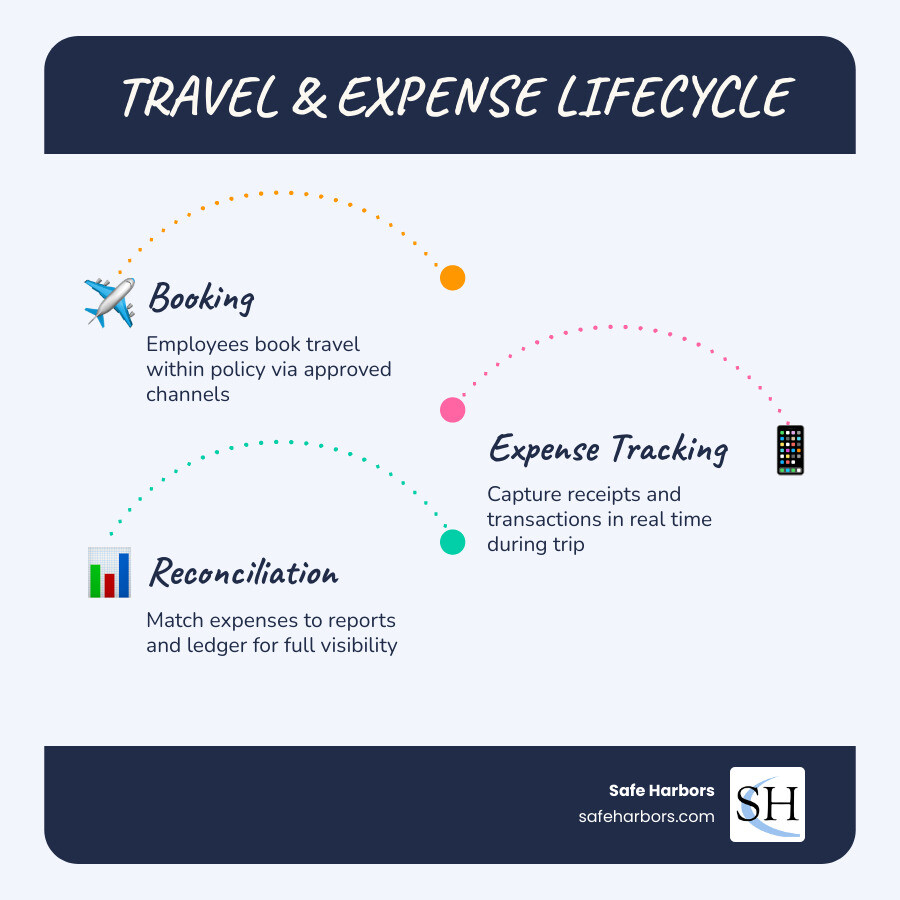
Here's a quick breakdown of what it involves:
- Booking control - ensuring employees book within policy and through approved channels
- Expense tracking - capturing receipts and transactions in real time
- Approval workflows - routing expenses to the right approvers automatically
- Reconciliation - matching card transactions to expense reports and general ledger entries
- Reporting & analysis - using spend data to cut costs and forecast budgets
Business travel is back — and the costs are climbing fast. Average global airfares are projected to hit $708 by 2026, with hotel rates approaching $166 per night. For many organizations, T&E is the second-largest controllable expense after payroll.
Yet the systems meant to manage that spend are often broken. A striking 83% of employees struggle to reconcile trip expenses, and 24% say their expense process is simply too complicated. Finance teams are buried in paperwork, travelers are frustrated, and real spending data arrives too late to act on.
The result? Overspending, delayed reimbursements, and zero visibility into where the money is actually going.
This guide walks you through every layer of the problem — and what modern, integrated solutions look like in practice.
I'm Jay Ellenby, President of Safe Harbors Travel Group, and over decades of leading global travel programs, I've seen how weak travel spend management erodes budgets and strains traveler trust. That experience shapes everything in this guide — from policy design to technology selection to cross-border compliance.
The Core Challenges of Modern Travel Spend Management
Managing travel expenses used to be a matter of collecting paper receipts in an envelope and stapling them to a spreadsheet. In today’s , global business environment, that "system" is more than just an annoyance—it’s a financial liability.
The friction starts with the traveler. When systems are clunky, employees often bypass them entirely. Research shows that 26% of business travelers use their personal credit cards for large purchases, often because the company's booking tool is too difficult to navigate or corporate card access is limited. This creates a "shadow spend" that finance teams can't see until weeks after the trip is over.

Furthermore, the administrative burden is staggering. For many companies, entering a single expense report can take 10 to 15 minutes of manual data entry. For a company with hundreds of travelers, this translates into thousands of wasted hours every year. When you add the fact that 28% of employees face delayed reimbursements, it’s easy to see why morale takes a hit.
We also have to contend with external economic pressures. With 60% of business travel buyers reporting spending volumes above 2024 levels according to the Global Business Travel Association, the sheer scale of transactions is growing. Without a robust Business Travel Expenses Guide, companies find themselves reacting to costs rather than controlling them.
Optimizing Travel Spend Management with Real-Time Visibility
The "holy grail" of finance is real-time visibility. Traditionally, finance teams only see travel costs during the reconciliation phase—long after the money has been spent. Modern travel spend management flips this script.
By integrating booking tools directly with expense systems, we gain a "live" view of liabilities. If an employee books a $900 flight today for a trip next month, that data should hit the finance dashboard immediately. This level of transparency allows for:
- Proactive Budget Tracking: Seeing exactly how much of a department's quarterly travel budget remains before more trips are approved.
- Spend Transparency: Identifying exactly which vendors are getting the most business, which is essential for a Spend Category Analysis that can lead to better negotiated rates.
- Financial Orchestration: Moving beyond simple digitizing of receipts to a system where spend, approvals, and data flow seamlessly across the business.
When we have the right data at the right time, we stop being "expense police" and start being strategic advisors to the business.
Scaling Travel Spend Management for Global Growth
As businesses expand, the complexity of travel expenses grows exponentially. Managing a trip from New York to Chicago is one thing; managing a multi-leg journey through London, Singapore, and Tokyo is quite another.
Global operations introduce the headache of multi-currency reconciliation. Traditional payment methods often hide costs in foreign exchange (FX) fees, with markups ranging from 0.35% to 2% depending on the currency pair. For companies with substantial international travel budgets, these fees accumulate rapidly.
Furthermore, international compliance is a moving target. Different regions have different tax requirements (like GST in Canada or VAT in Europe). A scalable system must be able to:
- Support 50+ currencies with real-time exchange rates.
- Automate tax categorization to ensure global compliance.
- Provide virtual cards that can be issued instantly for cross-border payments, eliminating the need for employees to carry large amounts of cash or use personal credit.
With global payments revenues forecast to hit $3.2 trillion by 2027, the infrastructure you use to manage these transactions will determine how efficiently you can scale.
Building a Robust Travel Expense Policy
A software tool is only as good as the policy it enforces. We often see companies with 60-page policy documents that no one reads. The most successful organizations simplify their guidelines and then bake them directly into their technology.
A modern Corporate Travel Spend Guide should clearly define:
- Eligible vs. Non-Reimbursable Expenses: Be specific. Is that airport lounge access covered? What about in-flight Wi-Fi?
- Spending Limits: Instead of flat rates, consider geo-specific per-diems. A hotel in San Francisco costs significantly more than one in Des Moines.
- Booking Windows: Encouraging employees to book 14 or 21 days in advance can save up to 30% on airfares.
- Approval Workflows: Define who needs to approve what. Automating this ensures that a $10 Uber receipt doesn't require the CFO's signature, while a $5,000 last-minute international flight is flagged immediately.
The goal is to move from "policing" to "guiding." When the policy is clear, 19% of employees who currently don't know what's reimbursable will suddenly have the confidence to spend responsibly.
Leveraging Technology for Seamless T&E Integration
The biggest leap forward in travel spend management comes from the "super system"—the total integration of travel booking and expense reporting. Businesses that integrate these two functions see an average of 21% savings in booking and reporting costs.
| Feature | Manual/Legacy Systems | Integrated T&E Systems |
|---|---|---|
| Data Entry | 10-15 minutes per report | Under 10 seconds |
| Visibility | Retroactive (post-trip) | Real-time (at booking) |
| Receipts | Paper-based / Easily lost | Digital / AI-captured |
| Compliance | Manual audits | Automated policy flagging |
| Reimbursement | Weeks | Days (or instant) |
By utilizing Reduce Business Travel Costs strategies, we emphasize the use of virtual and corporate cards. Virtual cards are particularly powerful; they allow finance teams to set a specific limit for a specific trip or merchant. Once the limit is reached or the trip is over, the card is deactivated. This eliminates overspending before it even happens.
Furthermore, direct synchronization with your ERP (Enterprise Resource Planning) or accounting software ensures that your general ledger is always accurate without the need for manual month-end reconciliations.
The Role of AI and Automation in Expense Control
Artificial Intelligence is no longer a futuristic concept—it is currently the "engine room" of efficient travel spend management. AI-powered tools transform the process from reactive to proactive.
One of the most immediate benefits is AI-powered receipt scanning. Using OCR (Optical Character Recognition) technology, a traveler can simply snap a photo of a receipt. The AI extracts the vendor, date, currency, and amount, then automatically matches it to a corporate card transaction. This addresses the 25% of employees who admit to losing paper receipts.
Beyond simple scanning, Automated Spend Analysis uses machine learning to:
- Detect Fraud: Flagging duplicate submissions or suspicious spending patterns that a human eye might miss.
- Enforce Policy: Automatically rejecting or flagging expenses that exceed set limits before they are even submitted.
- Predictive Analytics: Analyzing historical data to forecast future travel spend, helping finance teams set more accurate budgets.
Automation can improve processing speed by up to 60x. In one real-world case, a company reduced their expense report entry time from 15 minutes to just 10 seconds. That is the power of letting technology handle the "busy work" so your team can focus on strategy.
Frequently Asked Questions
How can businesses reduce hidden travel costs?
Hidden costs often lurk in foreign exchange fees, "leakage" (booking outside of approved channels), and administrative overhead. To reduce them, implement a single integrated platform, use multi-currency corporate cards with low FX markups, and mandate that all bookings occur within the system to capture negotiated vendor discounts.
What are the benefits of virtual corporate cards for international travel?
Virtual cards provide enhanced security and control. They can be issued in local currencies to avoid double-conversion fees and come with pre-set spending limits and merchant restrictions. This prevents "budget creep" and eliminates the risk of card theft or loss during international trips.
How does automation improve employee satisfaction and compliance?
Automation removes the "paperwork pain." When employees can submit expenses via a mobile app in seconds and receive reimbursements faster, their satisfaction scores soar. High satisfaction leads to higher adoption of the tool, which naturally drives better policy compliance and provides finance with better data.
Conclusion
Managing travel spend doesn't have to be a source of friction between finance teams and travelers. By combining clear policies, real-time visibility, and the latest in AI-driven automation, organizations can transform T&E from a chaotic cost center into a streamlined strategic advantage.
At Safe Harbors, we specialize in providing global business travel solutions that prioritize both the traveler’s experience and the company’s bottom line. Our white-glove service, combined with elite tech partnerships, ensures that your team has 24/7 support and the most flexible booking tools available. From duty of care to complex multi-currency reconciliation, we are here to ensure your travel program is optimized for success.
Ready to take the next step? Optimize your travel program with Safe Harbors today and see how we can help you turn travel spend into a competitive differentiator.