
Why Every Company Needs to Streamline Business Travel

Streamline business travel and you can cut costs, reduce admin time, and keep your employees safer on every trip. Here's how to do it fast:
- Set a clear travel policy - Define spending limits, booking rules, and approval workflows
- Automate booking and expenses - Use integrated platforms to eliminate manual work
- Enroll travelers in trusted programs - TSA PreCheck, Global Entry, and CLEAR save hours
- Manage passports and visas proactively - Renew early, check the six-month validity rule
- Use real-time data - Track spending, compliance, and risk from one dashboard
- Partner with a travel management company (TMC) - Get 24/7 support and duty of care coverage
Corporate travel is bouncing back fast. By 2028, global corporate travel spending is projected to exceed $2 trillion. Most companies have already recovered close to pre-pandemic levels.
But recovery doesn't mean efficiency.
Right now, travel coordinators spend 15 to 20 hours every month just on booking logistics and expense processing. Two-thirds of employees still book outside company policy. And when something goes wrong - a cancelled flight, a stranded crew, a medical emergency abroad - the gaps in most travel programs become painfully clear.
The pressure on travel managers is real. You're expected to control costs, protect employees, and keep everything moving - often with tools that weren't built to work together.
This guide walks you through exactly how to fix that.
I'm Jay Ellenby, President of Safe Harbors Travel Group, and I've spent decades helping organizations build smarter, safer, and more cost-effective travel programs - including complex international logistics and duty of care strategies that directly help companies streamline business travel at scale. In the sections ahead, I'll share the frameworks and tools that actually move the needle.
Establishing a Modern Framework to Streamline Business Travel
In many growing companies, organizing a business trip starts as a simple task but quickly transforms into a logistically complex tangle of hotel reservations, airline tickets, and train schedules. To streamline business travel effectively, we must move away from "spontaneous" arrangements and toward a structured framework.
The foundation of this framework is a transparent business travel policy. A well-crafted policy eliminates uncertainty by answering basic questions before they become headaches: Who is authorized to book? What are the nightly hotel price caps? Which airlines are preferred? When a policy is clear and accessible, employees don't have to guess, and managers don't have to spend hours policing every receipt.
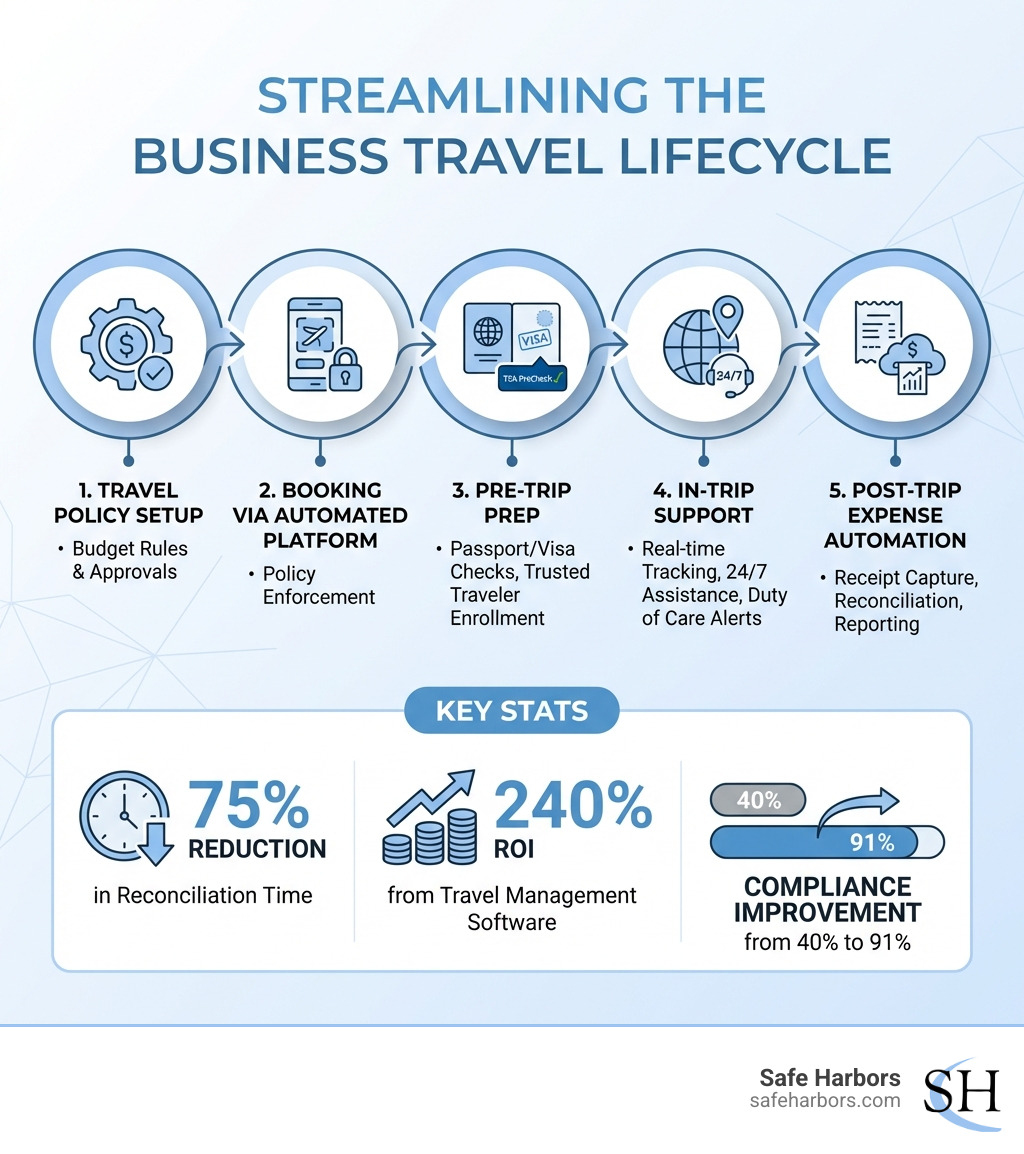
One of the biggest hurdles we see is the "compliance gap." Research shows that even when policies exist, two-thirds of business travelers admit to deviating from them. This isn't usually due to malice; it's often because the "official" way is too cumbersome. By integrating your policy into a modern business travel service, you can enforce rules at the point of sale. If a hotel is out of budget, the system simply doesn't show it as an option. This proactive approach drives policy compliance from a measly 40% up to an impressive 91%.
| Feature | Manual Booking | Automated Travel Management |
|---|---|---|
| Booking Time | 45+ minutes per trip | Under 5 minutes per trip |
| Policy Enforcement | Reactive (after the expense) | Proactive (during booking) |
| Reconciliation | 15-20 hours per month | Up to 75% time reduction |
| Visibility | Fragmented / Delayed | Real-time dashboard |
| Support | Employee handles disruptions | 24/7 expert assistance |
How to Streamline Business Travel with AI and Data Analytics
The role of the travel manager has shifted. It’s no longer just about booking flights; it’s about "data storytelling." In fact, more than 80% of travel managers say data is integral to their jobs today. We use data to look for "low-hanging fruit"—those missed opportunities where a slight change in behavior could save thousands.
AI-powered platforms now offer predictive modeling to suggest the best times to book or the most efficient routes based on historical trends. Imagine a system that knows your travelers prefer a certain hotel chain but also notices that a rival hotel across the street offers a negotiated corporate rate that could save you 15%. This level of personalization doesn't just save money; it improves the traveler experience. When you skyrocket corporate productivity with a TMC, you're leveraging these insights to make informed, strategic decisions rather than just reacting to the latest credit card statement.
Leveraging Technology for Booking and Expense Automation
If you want to streamline business travel, you have to kill the paper trail. Finance teams often find themselves drowning in credit card statements, trying to match crumpled receipts to specific projects. This manual reconciliation is a massive time-sink.
Modern T&E (Travel and Expense) integration solves this by connecting the booking platform directly to the expense software. When a traveler books a flight, the expense is automatically created, categorized, and tagged with the correct project code. This isn't just a marginal improvement; companies using integrated platforms can reduce reconciliation time by up to 75%. For an accountant spending 40 hours a month on travel math, that’s 30 hours reclaimed for strategic work.
There are 7 fundamental ways corporate travel management saves money, but one of the most powerful is direct billing. By consolidating all travel spend into a single monthly invoice, you eliminate the need for employees to pay out-of-pocket and wait for reimbursements. This also provides a massive shield against fraud. The Association of Certified Fraud Examiners (ACFE) estimates that organizations lose 5% of revenue to occupational fraud annually. Automated systems flag non-compliant spend or duplicate receipts instantly, ensuring every dollar spent is legitimate.
Optimizing International Logistics and Traveler Security
International travel presents a unique set of challenges, from flight cancellations to complex entry requirements. To streamline business travel on a global scale, you need a "proactive" rather than "reactive" mindset.
First, let's talk about the basics: passports. U.S. passport renewal times have recently decreased to 4-6 weeks, and many can now be renewed online. However, the biggest trap for international travelers is the "six-month rule." Many countries require a passport to be valid for six months beyond your date of departure. If your passport expires in five months, you might be denied boarding at the gate. We recommend reapplying at least nine months before expiration to avoid any surprises.
Beyond documents, "Duty of Care" is your most important responsibility. In an era where 58% of employees have changed travel plans due to safety concerns, you must know where your people are at all times. A global travel management guide 2025 should include real-time traveler tracking and automated risk alerts. If there’s a disruption in London, your platform should instantly identify which of your employees are in the area and provide them with a direct line to 24/7 assistance. Don't forget the small details either, like international driving permits for those renting vehicles in countries with different licensing laws.
Using Trusted Traveler Programs to Streamline Business Travel
Time is the most valuable asset for a business traveler. Spending 45 minutes in a security line is not just frustrating; it’s unproductive. Trusted Traveler Programs are the ultimate "hack" to streamline business travel.
- TSA PreCheck: Available at over 200 airports, it allows travelers to keep their shoes on and laptops in their bags.
- Global Entry: This is a must for international flyers. It includes TSA PreCheck and allows for expedited U.S. customs clearance via kiosks.
- CLEAR: This uses biometric technology (iris or fingerprint scans) to let travelers skip to the front of the security line.
- MPC App: For those without Global Entry, the MPC app for customs is a free tool that allows you to submit your declaration digitally, often letting you bypass long lines upon reentry to the U.S.
It is also important to note that by May 7, 2025, all domestic travelers will require a REAL ID to fly within the U.S. Ensuring your team is compliant now will prevent a logistical nightmare next year. If your current program doesn't actively promote these tools, it might be time to consider finding a new travel management company that prioritizes traveler efficiency.
Best Practices for Group Bookings and Project-Based Travel
Managing travel for a single executive is one thing; managing a 20-person construction crew or a project team is another beast entirely. Crew logistics require specialized handling. You need to track costs by project or "job code" so you can see if the Phoenix job is going over budget because of $300/night hotels or excessive meal expenses.
When handling groups, the "lowest price" isn't always the best value. A hotel that is 45 minutes away from a job site might be $20 cheaper, but you'll lose hundreds of dollars in lost productivity and transport costs. Look for hotels that offer free breakfast (saving $15-25 per person daily) and flexible cancellation policies. Project timelines change—permits get delayed, and weather happens. You need a booking platform that allows for last-minute changes without punitive fees.
Sustainability is also becoming a core part of project planning. Currently, 46% of travel managers monitor emission budgets for their teams. This isn't just about being "green"; it's about efficiency. Choosing rail over short-haul flights or selecting "green-certified" hotels often aligns with cost-saving goals. Following a 6-step guide to making the move to managed travel can help you transition from chaotic, manual group bookings to a streamlined system that lets you reduce business travel costs while keeping your crews happy and productive.
Frequently Asked Questions about Corporate Travel Efficiency
What is the ROI of adopting travel management software?
The ROI is significant and measurable. Independent research shows a 240% ROI over three years for a typical 1,000-employee organization. This is driven by a 75% reduction in reconciliation time, a 54% reduction in booking time, and massive savings from improved policy compliance (which typically jumps from 40% to over 90%). Beyond the numbers, you eliminate "hidden costs"—like the $600,000+ per year mid-sized companies often lose to manual process inefficiencies.
How can companies balance employee flexibility with budget control?
The key is "controlled autonomy." Use a booking platform that allows employees to choose their own flights and hotels but only within the guardrails of your policy. For example, you might allow any 4-star hotel within 5 miles of the office, provided it's under $250 a night. This gives the traveler the power to choose their preferred brand while ensuring the company stays on budget.
What are the essential packing tips for efficient business trips?
To streamline business travel, we always recommend:
- Carry-on only: Avoid checked bag fees and the risk of lost luggage.
- The "Rolling" Method: Roll your clothes to save space and prevent wrinkles.
- Tech Prep: Keep a dedicated "travel kit" with spare chargers and international adapters so you never have to scramble before a flight.
- Airport Ready: Pack your liquids and electronics in easily accessible pockets to breeze through security.
Conclusion
At Safe Harbors, we believe that business travel should be a catalyst for growth, not a source of stress. We specialize in helping organizations streamline business travel through a unique blend of elite technology and white-glove concierge service. Whether it's our unmatched response speed, our comprehensive duty of care protocols, or our ability to navigate complex global logistics, we act as a true partner for your team.
Efficiency isn't just about a faster booking tool; it's about a support system that's there for you 24/7 when plans change. Ready to reclaim your time and optimize your travel spend? Streamline business travel for your organization today and experience the difference that expert management can make.