What Corporate Travel Managers Need to Know About VIP Business Flight Booking

VIP business flight booking has become a critical tool for corporate travel managers who need to move executives and delegations quickly, safely, and without the friction of commercial aviation.
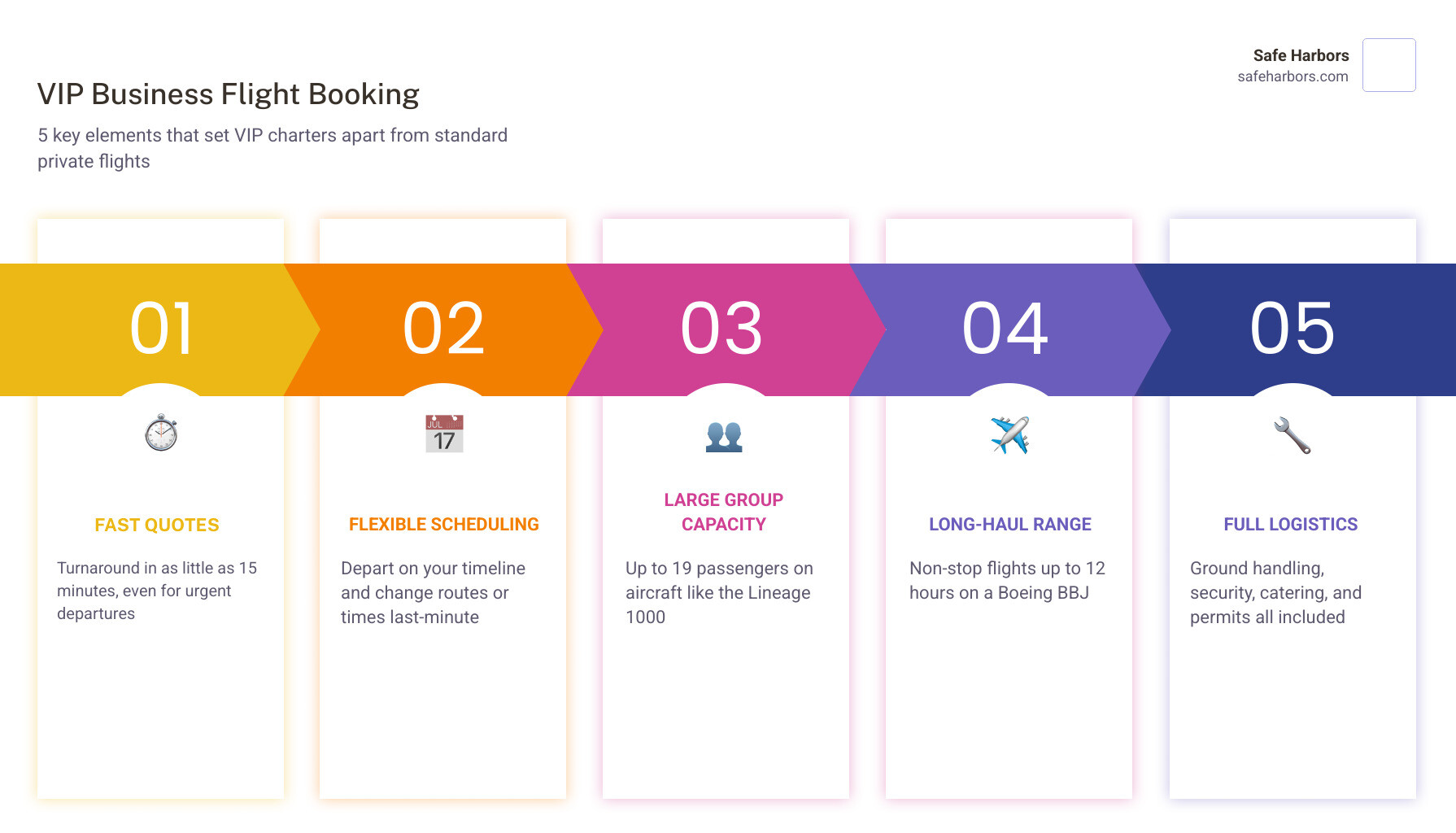
Here's a quick overview of what it involves:
| What You Need | What VIP Charter Delivers |
|---|---|
| Fast quotes | Turnaround in as little as 15 minutes |
| Flexible scheduling | Depart on your timeline, change routes last-minute |
| Large group capacity | Up to 19 passengers on aircraft like the Lineage 1000 |
| Long-haul range | Up to 12 hours non-stop on a Boeing BBJ |
| Full logistics support | Ground handling, security, catering, permits included |
| Cost control | Empty-leg flights offer up to 70% off standard rates |
For corporate travel managers, the stakes are high. Slow booking systems, disjointed logistics, and gaps in duty of care don't just cause frustration — they create real risk for your travelers and your organization.
VIP charter isn't just about comfort. It's about control: over timing, routing, security, and the full travel experience from door to door.
I'm Jay Ellenby, President of Safe Harbors Travel Group, and over decades of managing complex global travel — including executive and high-stakes corporate itineraries — I've seen how the right VIP business flight booking strategy can eliminate disruptions and strengthen duty of care. In the sections ahead, I'll walk you through everything you need to make confident, informed decisions for your organization.
Understanding VIP Business Flight Booking vs. Standard Private Charters
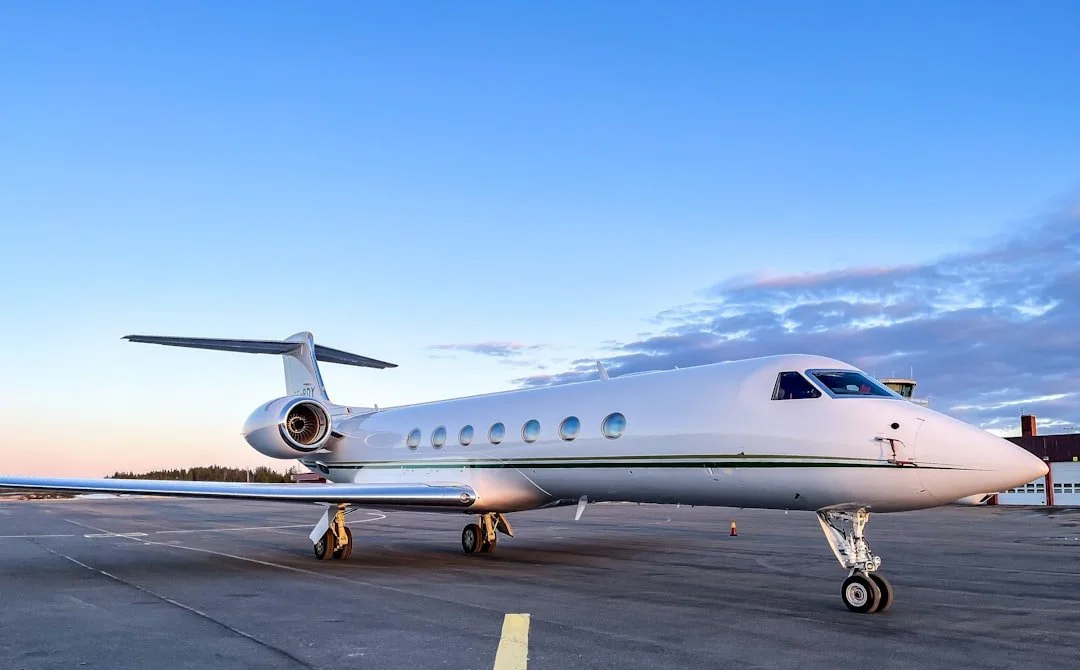
To the uninitiated, all private flights might look relatively similar. You bypass the crowded commercial terminals, board a sleek aircraft, and fly directly to your destination. However, in the realm of high-end corporate logistics, there is a massive operational gulf between booking a standard light cabin private jet and securing a true VIP airliner charter. Understanding this distinction is the first step toward optimizing your business flight booking strategy.
Standard private jet charters typically utilize light, midsize, or super-midsize aircraft. These planes are excellent for small teams of four to eight passengers traveling regional distances. They are the workhorses of corporate travel, but they come with physical limitations. Their cabins, while comfortable, do not allow for multiple separate living areas, and their baggage compartments are often restricted to a few soft-sided suitcases.
In contrast, VIP airliners—often referred to as "bizliners"—are commercial-sized aircraft from manufacturers like Airbus and Boeing that have been completely retrofitted with ultra-luxury, low-density interiors. Instead of packing in 150 commercial passengers, these massive aircraft are configured to carry executive delegations of 15 to 19 people in absolute comfort. When you coordinate a VIP corporate travel booking on a bizliner, you are securing a flying boardroom, a private dining room, and a luxury suite all in one.
Key Differences in Capacity and Range for VIP Business Flight Booking
The physical scale of VIP airliners translates directly into superior range and capacity. Consider the Embraer Lineage 1000, a staple of elite charter fleets. It boasts a flight range of up to 9 hours and accommodates up to 19 passengers. More importantly for corporate delegations traveling with presentation gear, product samples, or extensive personal luggage, it features a massive baggage capacity capable of holding 30 to 60 large bags weighing 20kg each.
For even longer intercontinental journeys, the Boeing Business Jet (BBJ) stands as a premier option. With a flight range extending up to 12 hours, a BBJ can easily fly a delegation from New York to Tokyo or London to Johannesburg non-stop. While its seating is typically configured for around 18 passengers to maximize space and comfort, its engineering allows corporate teams to work, sleep, and dine without the fatigue associated with long-haul commercial flights.
To help visualize how these options compare, let us look at the operational parameters of these aircraft side-by-side:
| Aircraft Class / Model | Typical Passenger Capacity | Maximum Flight Range | Baggage Allowance (20kg bags) | Best Suited For |
|---|---|---|---|---|
| Standard Light Jet (e.g., Phenom 300) | 6 - 8 passengers | 3 - 4 hours | 4 - 6 bags | Regional executive trips, quick site visits |
| VIP Airliner: Lineage 1000 | 19 passengers | Up to 9 hours | 30 - 60 bags | Large corporate delegations, multi-city regional summits |
| VIP Airliner: Boeing BBJ | 18 passengers | Up to 12 hours | 10 - 20 large bags | Intercontinental executive travel, diplomatic missions |
Safety Certifications and Standards in VIP Business Flight Booking
When arranging travel for high-profile executives, board members, or key corporate delegations, safety is the single most important variable. We cannot emphasize this enough: never assume that because an aircraft looks luxurious, the operator adheres to the highest safety standards. In our decades of managing corporate travel, we have established strict protocols to verify that every charter operator we work with holds independent, gold-standard safety credentials.
The two most critical safety certifications you should look for are the ARGUS Platinum rating and the IS-BAO Stage 3 compliance. ARGUS is an independent, third-party safety rating system that conducts exhaustive on-site audits of operators, checking everything from pilot flight hours and training histories to maintenance records and operational safety cultures. A Platinum rating is the highest grade ARGUS awards, indicating an operator with a flawless safety record and highly experienced crews.
Similarly, the International Standard for Business Aircraft Operations (IS-BAO) features a three-stage certification process. Achieving IS-BAO Stage 3 is a major milestone. It proves that the operator does not just have a safety manual sitting on a shelf, but has fully integrated a highly active Safety Management System (SMS) into their daily culture. At this level, safety risks are being proactively managed, analyzed, and mitigated on every single flight.
Elite Aircraft Models and In-Flight Amenities
For long-haul executive missions, the environment inside the cabin is not a luxury—it is a productivity tool. When your leadership team steps off a twelve-hour flight, they need to be rested, prepared, and ready to walk straight into high-stakes negotiations. This is where the world’s elite business jets and VIP airliners truly shine, offering an experience that far surpasses even the best commercial business class air travel.
The global charter market features a diverse array of ultra-large cabin business jets and VIP bizliners. Renowned manufacturers like Gulfstream (with the G650 and G700), Bombardier (with the Global 7500), and Dassault (with the Falcon 8X) dominate the long-range business jet sector. Meanwhile, converted airliners from Airbus and Boeing offer unmatched physical space. These aircraft are divided into distinct zones, allowing some team members to conduct confidential briefings in a soundproofed conference area while others sleep in private staterooms equipped with queen-sized beds and stand-up showers.
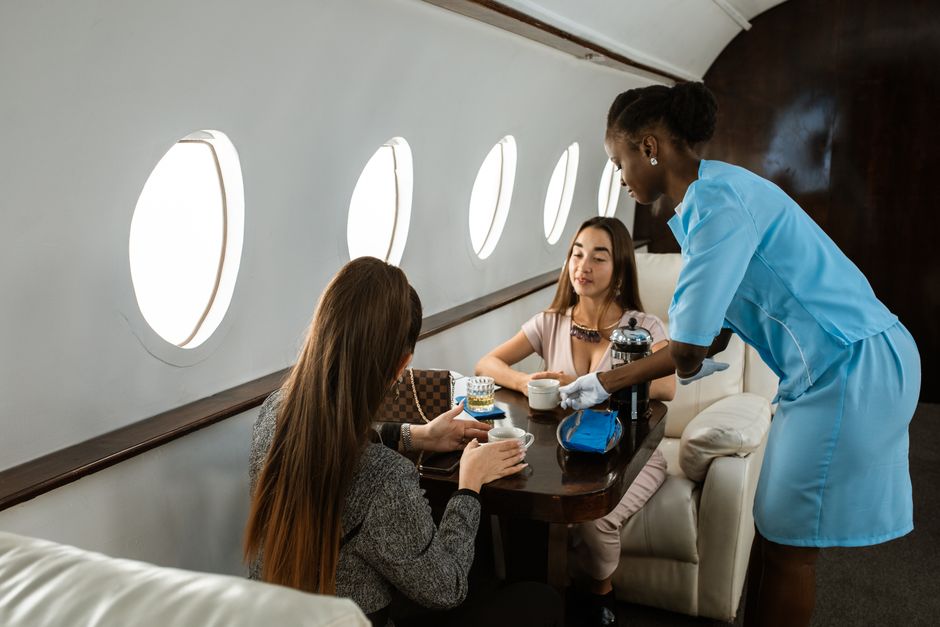
The in-flight service on these aircraft is entirely bespoke. Rather than choosing between standard commercial meal options, corporate travelers enjoy custom fine dining menus curated in advance by dedicated culinary teams. Whether your team requires specific dietary accommodations, organic local ingredients, or Michelin-star caliber cuisine, every meal is prepared fresh and served by a highly trained cabin crew who specialize in discreet, professional service.
Furthermore, VIP charter flights offer unparalleled flexibility for unique passenger requirements, including pet-friendly travel. On a commercial flight, pets are often relegated to the cargo hold—a stressful and potentially dangerous experience. On a VIP corporate flight, your executives' companion animals travel right alongside them in the cabin, complete with tailored amenities and specialized care, ensuring peace of mind for the entire traveling party.
Logistics, Scheduling, and Ground Handling Services
The magic of a successful VIP flight does not just happen in the air; it is meticulously engineered on the ground. For corporate travel managers, the primary appeal of private aviation is scheduling flexibility. If a critical meeting runs two hours late, the aircraft does not leave without your team. The crew simply adjusts, updates the flight plan, and waits for your arrival. This level of responsiveness is invaluable when managing complex, multi-leg itineraries that would be impossible to execute using commercial schedules.
However, moving an aircraft across international borders on a fluid schedule requires a massive amount of behind-the-scenes coordination. Flawless execution relies heavily on elite ground handling services. When operating diplomatic missions or high-profile corporate trips, ground handlers must manage airport slots, Prior Permission Required (PPR) coordinates, parking approvals, and rapid aircraft fueling. During major international summits, securing these slots early is a critical operational hurdle.
To ensure a seamless transition from road to runway, we coordinate comprehensive white-glove logistics that extend far beyond the flight itself. This includes arranging executive security, secure passenger and crew ground transport, and expedited customs and immigration clearance. By utilizing private Fixed-Base Operators (FBOs), passengers completely bypass the main airport terminal, stepping from their secure vehicle directly onto the tarmac.
For specialized regional operations, we partner with trusted local handling experts. For instance, companies like VVIP Flight specialize in managing the intense logistical demands of head-of-state and corporate flights across South Asia, including India, Nepal, Bhutan, Sri Lanka, and the Maldives. Whether it is coordinating diplomatic flight permits through local ministries or rapidly reuniting a passenger with lost luggage at a remote secondary airport, having a dedicated partner on the ground ensures that no detail is overlooked. This level of care is the hallmark of a true concierge level service complete guide and is central to our executive concierge service philosophy.
Maximizing Value: Empty Legs and Spend Management
While VIP travel is undeniably an investment, responsible corporate travel managers must always look for opportunities to optimize budgets. This is where "empty-leg" flights become a powerful tool. An empty leg occurs when a private aircraft needs to reposition to another airport to pick up its next charter or return to its home base after completing a one-way mission. Because the operator has already factored the cost of this positioning flight into the original client's booking, they are highly motivated to sell the empty leg to another traveler at a steep discount.
By booking empty legs, corporate travel departments can secure the exact same luxury aircraft, elite crews, and private terminal access for up to 70% off standard charter rates. To find these opportunities, we utilize advanced digital sourcing tools. For example, platforms like JETVIP provide real-time access to over 9,000 certified aircraft and collaborate directly with more than 1,000 operators worldwide. On any given day—such as July 15, 2026, when 17 distinct empty legs were actively listed—travel managers can scan global routes to match upcoming executive travel needs with available repositioning flights.
Integrating these opportunities into your broader corporate travel strategy requires a structured approach to travel spend management complete guide. Because empty legs are subject to the scheduling demands of the primary charter, they are best suited for flexible travel windows or last-minute regional trips.
To ensure compliance and maintain financial oversight, travel managers should address these unique booking scenarios within their corporate guidelines. Defining exactly when a VIP charter or an empty-leg flight is authorized—and documenting these parameters in your corporate travel policy 9 common business travel policy questions—allows your organization to balance executive productivity with fiscal responsibility.
Frequently Asked Questions about VIP Corporate Travel
What is the typical response time for a VIP charter quote?
In business aviation, speed is everything. When you utilize modern booking technology and experienced brokers, a tailored charter quote can be prepared in as little as 15 minutes. For urgent or emergency situations, such as a sudden corporate evacuation or a critical business crisis, an entire flight can be organized and ready for departure in 2 to 4 hours.
While automated booking algorithms have improved, we have found that live expert review is still vastly superior. A dedicated aviation expert manually verifies route fees, airport slot availabilities, and positioning logistics to ensure that the initial price you receive is fixed, accurate, and completely free of hidden surcharges.
How do baggage allowances compare on VIP airliners?
Baggage allowances on VIP airliners are exponentially larger than those of standard private jets or commercial first-class cabins. Because these aircraft are built on commercial airframes, they feature massive cargo holds.
For example, a VIP Embraer Lineage 1000 can easily accommodate between 30 and 60 large bags weighing 20kg each. Even a Boeing BBJ, depending on its internal auxiliary fuel tank configuration, offers generous space for 10 to 20 large bags. This makes VIP airliners the ideal choice for corporate delegations traveling with heavy presentation equipment, trade show materials, or extensive luggage for multi-week international roadshows.
Can corporate travel policies accommodate VIP charter flights?
Yes, but it requires clear guidelines and the right technology. Many organizations integrate private charter parameters directly into their corporate travel policies, specifying that charters are authorized for groups above a certain size, high-security missions, or routes poorly served by commercial airlines.
To streamline this process, travel managers can configure their corporate booking tool to flag charter options when commercial routes fail to meet efficiency or safety standards. Understanding the benefits of a managed corporate online booking tool allows organizations to keep all travel data—including commercial flights, hotel bookings, and private charters—centralized in a single, auditable system, reinforcing duty of care and budget control.
Conclusion
Navigating the complex world of VIP corporate travel requires more than just booking a flight; it demands an unwavering commitment to safety, precision logistics, and seamless execution. From verifying ARGUS Platinum ratings to coordinating ground handling with local experts in remote destinations, every detail matters when your organization’s leadership is in transit.
At Safe Harbors, we provide global business travel solutions that combine elite technology with unmatched white-glove service. Our rapid response times and dedicated support ensure that your executives are cared for at every step of their journey, keeping your business moving forward without interruption. For a deeper look at how we elevate the executive travel experience, explore our corporate travel concierge ultimate guide.
Ready to streamline your organization’s high-stakes travel logistics? Contact our team today to discover how our tailored solutions can support your business at Safe Harbors Business Travel Services.