What Your Business Travel Reporting Is Actually Trying to Tell You

Business travel reporting is how companies track, document, and analyze every dollar spent when employees travel for work — from flights and hotels to meals and mileage.
Here's what it covers at a glance:
| What It Tracks | Why It Matters |
|---|---|
| Transportation, lodging, meals, incidentals | Ensures accurate reimbursement and tax deductions |
| Policy compliance per expense | Flags out-of-policy spend before it compounds |
| Processing and admin costs | Reveals hidden operational waste |
| Receipts, dates, destinations, business purpose | Protects against IRS audits |
| Aggregate travel spend trends | Informs smarter budgeting and vendor negotiations |
Most travel managers think of expense reporting as a back-office task. It isn't. It's a signal — one that tells you whether your travel program is running efficiently, whether your policy is being followed, and whether your finance team is drowning in preventable admin work.
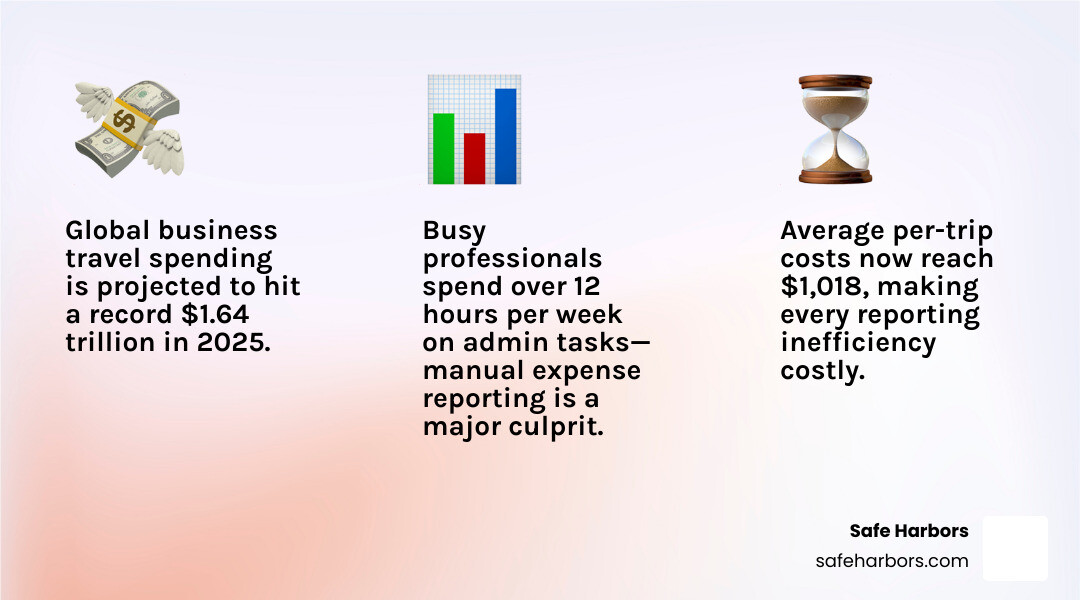
The numbers make the stakes clear. Global business travel spending is projected to hit a record $1.64 trillion in 2025, with average per-trip costs reaching $1,018. At that scale, even small reporting inefficiencies add up fast. And that's before you account for the hidden toll: busy professionals already spend over 12 hours per week on administrative tasks, and manual expense reporting is one of the biggest culprits.
The trip itself is rarely the hard part. The cleanup after — the pockets full of crumpled receipts, the half-remembered meal charges, the Friday afternoon spent reconstructing a week of spending — is where time and money quietly disappear.
I'm Jay Ellenby, President of Safe Harbors Travel Group, and I've spent decades helping organizations build smarter, more efficient travel programs — including the business travel reporting systems that keep them compliant, cost-controlled, and audit-ready. In this guide, I'll show you exactly what your reporting data is telling you, and what to do about it.
Decoding the Hidden Signals in Your Business Travel Reporting
When we look at a standard stack of travel receipts, we are only seeing the surface. Below those individual line items lies a wealth of operational data that can transform how a company handles capital. Many organizations fail to realize that their business travel reporting is a diagnostic tool for the health of their entire financial workflow.
One of the most significant blind spots for businesses is the actual cost of processing a single expense report. Many companies do not track this metric, creating a hidden expenditure pit where administrative resources are silently drained. When we fail to calculate the labor hours spent on manual verification, data reconciliation, and chasing down missing paperwork, we overlook a major operational cost. By shifting toward an optimized system, as outlined in our Travel Expense Management Guide 2026, we can turn these administrative black holes into clear, actionable data.
Optimizing expense reporting data does not just clean up the travel budget; it directly enhances broader finance functions. When travel data is consolidated and accurate, it feeds directly into accounts payable invoicing, strengthens vendor negotiations with real-world volume data, and improves cash flow forecasting. Instead of reacting to last month’s surprise credit card bills, finance leaders can use real-time reporting to predict upcoming travel liabilities and adjust corporate spending dynamically.
The Attention Tax: The Real Cost of Manual Tracking
We often talk about the financial cost of travel, but we rarely calculate the cognitive toll. Manual expense management acts as an "attention tax" on our most valuable employees. When a sales executive, a startup founder, or a senior consultant spends hours sorting through crumpled receipts, they are not focus-locked on closing deals or building products. They are drowning in administrative drag.
Consider the classic scenario of a traveler landing late on a Friday evening, dropping their bags, and emptying a pocketful of faded receipts, unreadable boarding passes, and hotel folios onto the kitchen counter. This manual process is highly prone to errors. Receipts get lost, and memory fades over the weekend. When employees are forced to reconstruct their business travel weeks after the actual trip, they waste hours trying to remember the business context of a coffee meeting or a rideshare trip.
Relying on manual workflows also increases the risk of out-of-policy spending and fraud. Without immediate, digital tracking, finance teams only discover policy violations weeks after the money has already been spent. This delay forces accountants to act as corporate detectives, chasing down employees for clarification and creating unnecessary friction. If you find your team constantly dealing with these issues, you might want to look at the Top 15 Reasons Why Your Travel Expenses Could Be Higher Than You Expect to identify where your manual processes are breaking down.
Transitioning from Paper to Digital Business Travel Reporting
Moving away from paper payments and manual spreadsheets is no longer an optional upgrade; it is a fundamental requirement for modern business efficiency. The transition to paperless payments and mobile expense reporting tools allows travelers to capture expenses the moment they occur. Instead of saving paper slips in a wallet, a traveler can simply snap a photo of a receipt at the dinner table and let the software extract the data instantly.
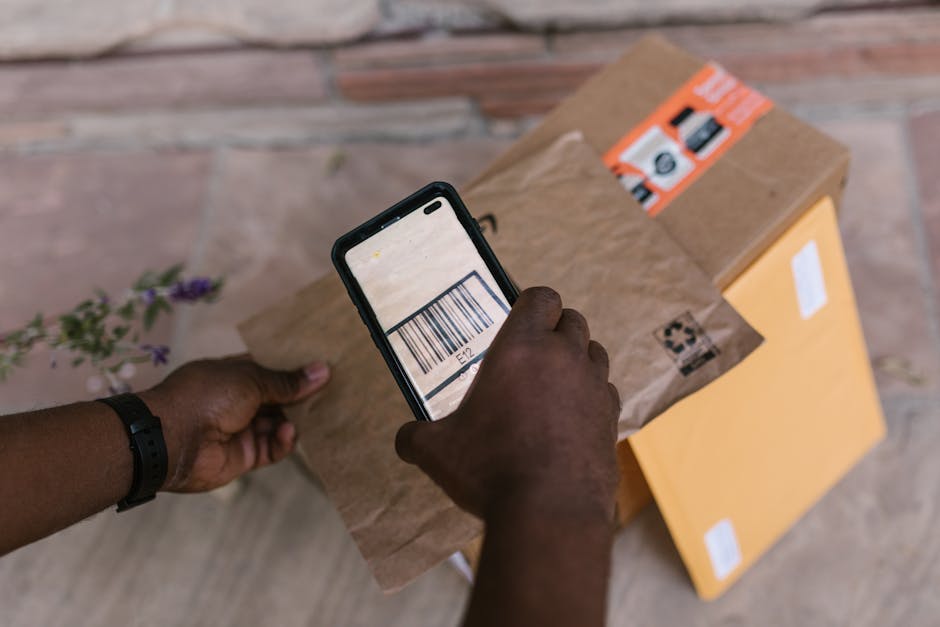
Immediate capture shifts the responsibility of expense tracking from a historical reconstruction project to a real-time habit. When a receipt is digitized instantly, the risk of loss drops to zero, and the business context remains fresh in the traveler's mind. To help visualize this transition, let us look at how traditional manual reporting compares to a modern automated workflow:
| Process Step | Manual Expense Reporting | Automated Digital Reporting |
|---|---|---|
| Receipt Collection | Physical paper slips kept in wallets, folders, or pockets | Immediate digital capture via mobile app scanning |
| Data Entry | Manual typing into spreadsheets at the end of the month | Automated OCR data extraction from receipt images |
| Policy Check | Manual review by managers and finance team members | Real-time automated flags for out-of-policy charges |
| Reconciliation | Matching paper receipts to credit card statements by hand | Automatic tech-enabled matching of transactions |
| Reimbursement | Weeks of processing, manual checks, or payroll adjustments | Rapid digital approval and direct deposit integration |
Transitioning to a digital workflow requires a shift in company culture, but the payoff in saved time and reduced errors is immediate. For a deeper dive into establishing these digital workflows, you can refer to our comprehensive resource on Business Travel Expenses: A Complete Guide for 2026 · Approved Experiences .
Designing a Frictionless Policy and Automating Adherence
A travel policy should never feel like a barrier to productivity. Instead, a well-designed policy provides clear guardrails that allow travelers to make fast, compliant decisions while protecting the company's bottom line. When we design policies with clarity in mind, we naturally reduce friction between travelers and the finance department, keeping our overall travel spend under control. For strategies on structuring your corporate budget around these goals, explore our Corporate Travel Spend Guide.
Building a Clear Travel Expense Policy
The biggest mistake we see in corporate travel policies is the use of vague, open-ended language. Phrases like "use good judgment," "choose reasonable lodging," or "keep meals modest" are highly counterproductive. What is "reasonable" to a junior sales representative might look incredibly lavish to a conservative CFO. Vague guidelines push the decision-making process downstream, forcing employees to guess what is acceptable and leaving managers to enforce unwritten rules.
A usable policy must replace gray areas with concrete, unambiguous guidelines. Instead of telling employees to be reasonable, specify exact daily limits for meals, clear star-rating caps for hotels, and approved booking windows for flights. When the rules of the road are clear, travelers can book their trips with confidence, and managers can approve reports without second-guessing every line item. For a closer look at balancing traveler satisfaction with financial oversight, check out our analysis of The Business Travel Managers Dilemma Keeping Finance and Your Travelers Happy.
The Power of Automated Policy Adherence
Even the clearest written policy can fail if it relies entirely on human memory. This is where automated policy adherence through modern expense management software becomes invaluable. By embedding your company's rules directly into your booking and expense systems, you can flag or block out-of-policy expenses at the point of purchase.
If a traveler attempts to book a luxury hotel room that exceeds the corporate limit, the system can instantly alert them to choose an alternative or require a manager's approval before the booking can be finalized. This proactive approach stops non-compliant spending before it occurs, rather than forcing the finance team to deny reimbursement after the trip is over. Implementing these automated guardrails is a core component of our Automated Spend Analysis solutions, which help businesses maintain continuous control over their budgets.
Modernizing Payments: Corporate Cards and Digital Wallets
The tools we use to pay for travel are just as important as the systems we use to track it. Modern payment methods do more than just replace cash; they serve as data-rich entry points that feed directly into our business travel reporting ecosystem. Transitioning to integrated payment systems is a key step in our Spend Management Solutions.
Eliminating Out-of-Pocket Friction
Forcing employees to use their personal credit cards for business travel is a recipe for administrative friction. It places an unfair financial burden on travelers, who must carry business debts on their personal lines of credit while waiting for reimbursement. It also introduces significant security and identity theft risks when employees use personal cards across various travel vendors globally.

Switching to a corporate card program combined with digital wallets removes this out-of-pocket friction entirely. Digital cards can be provisioned instantly to an employee's smartphone, allowing them to pay securely for rideshares, meals, and hotels while on the road. Furthermore, corporate cards often come with valuable perks — such as airport lounge access, travel insurance, and hotel upgrades — that make business travel more comfortable and foster stronger ties between employers and employees. To learn more about how corporate card integration can drive down administrative costs, read about the 7 Fundamental Ways Corporate Travel Management Saves Money.
Automated Data Reconciliation
One of the most tedious tasks in manual accounting is matching paper receipts to monthly credit card statements. It is a slow, error-prone process that wastes hours of valuable finance team time.
Modern expense systems solve this through automated data reconciliation. When an employee makes a purchase on a corporate card, the transaction data is instantly piped into the expense software. The system then leverages tech-enabled receipt matching to automatically link the digital receipt captured by the employee to the corresponding credit card transaction. This eliminates manual verification entirely, ensuring that every charge is accounted for and categorized correctly without human intervention. This level of precision is critical for accurate Spend Category Analysis, giving you a clear picture of where your travel capital is going.
Building an Audit-Proof System and Avoiding Costly Mistakes
An audit is not something any business wants to face unprepared. When it comes to business travel, the IRS scrutinizes deductions closely. Building an audit-proof documentation system is not just about keeping the tax authorities happy; it is about establishing a robust framework of financial integrity. For a detailed breakdown of how to protect your business during tax season, read our guide on How to Track and Claim Business Travel Expenses Without IRS Audits - My Financial 101 My Financial 101 .
The Four Fields of Audit-Proof Documentation
To satisfy IRS guidelines and protect your travel deductions, every single business expense must be backed by contemporaneous logging. This means capturing the details of the expense at the time of the trip, rather than trying to recreate them months later. Every logged expense must include four essential fields:
- Amount: The exact cost of the transaction, matching the receipt and bank record.
- Date: The precise day the expense was incurred.
- Place: The specific location, vendor, or establishment where the transaction occurred.
- Business Purpose: A clear, brief description of why the expense was necessary for business operations (e.g., "Client dinner with Acme Corp to discuss Q3 contract renewal").
Relying on memory is a dangerous strategy; a single gap in a log can unravel an otherwise clean return during an audit. For more details on maintaining compliance across all categories of spend, consult our Business Travel Expenses Guide.
Common Expense Reporting Mistakes to Avoid
Even with the best intentions, companies frequently fall into predictable traps that complicate their financial reporting. One of the most common mistakes is delayed logging. When employees wait until the end of the month or the end of the quarter to submit their expenses, receipts go missing, and the business context is lost.
Another frequent issue is the use of vague descriptions. Entering "dinner" or "travel" as the business purpose does not meet IRS standards and will not survive an audit. Furthermore, mixed-purpose trips — where employees combine a business trip with a weekend vacation — often lead to confusion. Without clear policies separating business days from personal days, companies risk claiming non-deductible personal expenses. Finally, incorrect categorization (such as labeling a client entertainment event as a standard business meal) can lead to compliance issues and incorrect tax filings. To learn how to eliminate these common errors and streamline your reporting, check out our strategies to Reduce Business Travel Expenses.
Navigating the 2026 Economic Landscape and IRS Compliance
As we navigate the economic landscape of July 2026, business travel budgeting requires more precision than ever. Fluctuating costs and shifting market indicators mean that static budgets are no longer effective. Companies must rely on real-time data to adjust their travel strategies. To stay ahead of these trends, businesses are increasingly leveraging Corporate Travel Data Analytics to make informed decisions.
How Macroeconomic Trends Impact Business Travel Reporting in 2026
Macroeconomic factors play a direct role in how we budget and track travel. For example, gasoline prices in June 2026 averaged 358.5 cents per gallon. While this represented a 9.7% drop from May 2026, it was still a substantial 26.7% increase year-over-year. This volatility directly impacts mileage reimbursement tracking and ground transportation costs, requiring companies to adjust their travel budgets dynamically.
Similarly, indicators like housing starts — which saw 1.2 million new privately-owned units started in May 2026, a 15.4% drop from April — signal shifts in travel patterns for industries like construction, consulting, and real estate development. When regional economic activity slows or accelerates, travel frequency and budgeting must adapt accordingly. Tracking these trends through Analytics for Travel allows businesses to pivot their travel spending before inefficiencies impact the bottom line.
IRS Requirements and Self-Employed Compliance
For self-employed workers and independent contractors, staying compliant with IRS Publication 463 is critical. The IRS enforces strict guidelines to ensure that personal travel is not disguised as business deductions.
To qualify for travel deductions, a trip must pass the "away from home" test, which requires the traveler to leave their general tax home overnight for a period longer than an ordinary day's work. For vehicle expenses, self-employed workers must choose between tracking actual costs (such as gas, oil, and depreciation) or using the standard IRS mileage rate, which is set at 67 cents per mile for 2026. Whichever method is chosen, contemporaneous logging remains non-negotiable. Gaining a clear understanding of these rules is vital for self-employed professionals looking to Reduce Business Travel Costs without risking an audit.
Frequently Asked Questions about Business Travel Expenses
To help you navigate the complexities of travel compliance and reporting, we have compiled answers to some of the most common questions we receive from businesses and travelers.
Can I deduct travel to a client’s office if I’m not staying overnight?
No. Under IRS rules, a day trip to a local client’s office does not meet the "away from home" test. The IRS views daily travel within your general tax home as a standard commute, which is not deductible. To claim travel deductions, your business trip must require you to stay overnight or sleep to meet the demands of your work before returning home.
What if I take a family member on a business trip?
You can only deduct the travel expenses of a family member if they are an employee or a business partner of your company, and their presence on the trip serves a real, documented business purpose. If your spouse or child joins you for personal reasons, their flights, meals, and personal expenses are strictly non-deductible. However, you can still deduct 100% of the business-related costs you would have incurred alone, such as the single-room rate for your hotel.
Are business meals 100% deductible in 2026?
No. In 2026, business meals are generally subject to a 50% deductibility limit. To qualify for this deduction, the meal must not be lavish or extravagant under the circumstances, and you or an employee must be present when the food is served. Additionally, the meal must be directly related to the active conduct of your business, such as negotiating a contract or discussing a project with a client.
Conclusion
Your business travel reporting is trying to tell you a story. It tells you where your team's focus is being drained, where your policy is failing to provide clear guidance, and where manual workflows are costing you valuable time and capital. By listening to these signals and modernizing your travel program, you can transform expense tracking from an administrative burden into a competitive advantage.
At Safe Harbors, we provide global business travel solutions that eliminate the friction of travel management. Our unmatched response speed, elite technology partnerships, and comprehensive white-glove concierge service ensure that your travelers stay safe, your policies remain compliant, and your financial workflows run seamlessly. Let us help you take control of your travel data and Optimize Business Travel Spend across your entire organization.
Ready to reclaim your team's focus and build an audit-proof travel program? Partner with Safe Harbors for Business Travel Services today.