

Why Virtual Payment Solutions Are Changing How Businesses Pay

Virtual payment solutions are digital tools that let businesses and consumers send and receive money without using physical cash, checks, or cards. Here's a quick overview of the main types:
| Type | What It Does | Best For |
|---|---|---|
| Virtual Cards | Generates a unique 16-digit card number per transaction | Supplier payments, travel, subscriptions |
| Virtual Bank Accounts | Dedicated digital accounts with local IBANs | Cross-border collections, multi-currency |
| Virtual Terminals | Web-based portals to accept payments anywhere | Remote teams, service businesses |
| Digital Wallets | Store and move funds without a bank account | Gig workers, consumers, global payments |
The way businesses pay — and get paid — has changed fast. Paper checks are slow, expensive, and easy to fraud. Wire transfers are clunky. And managing dozens of supplier payments by hand drains finance teams of time they don't have.
Virtual payments fix most of these problems. They're faster, more secure, and far easier to reconcile. Platforms like Mangopay have processed over €68 billion in transactions and report users spending 34% fewer hours on payment operations — that's a meaningful shift in how finance teams work.
For corporate travel managers specifically, the stakes are even higher. Every booking, hotel stay, and flight needs to be tracked, controlled, and reconciled — often across multiple currencies and time zones. Virtual payment tools built for travel programs make that possible without the manual chaos.
I'm Jay Ellenby, President of Safe Harbors Travel Group, and over decades leading global travel management I've seen how the right virtual payment solutions can transform expense control, duty of care, and reconciliation for corporate travel programs. In the sections below, I'll break down exactly how these tools work — and how to choose the right ones for your organization.
Core Types of Virtual Payment Solutions for Modern Businesses
As we navigate the landscape of digital finance in June 2026, virtual payment solutions have graduated from a cutting-edge luxury to an absolute necessity. Businesses operating in global commerce require immediate, frictionless transactions. The foundation of this shift lies in how we handle transaction verification. Rather than relying on physical signatures, plastic cards, or paper documents, virtual solutions utilize secure, digital authentication protocols to verify identity and authorize the transfer of funds.
By providing a highly secure digital alternative to legacy systems, these tools streamline cash flow and protect corporate assets from modern cyber threats. Let's look at the core types of virtual infrastructure keeping modern enterprises moving.
What is Virtual Payment Processing?
At its most basic level, virtual processing refers to any system that handles electronic financial transactions over digital channels without requiring a physical card, check, or in-person bank visit.
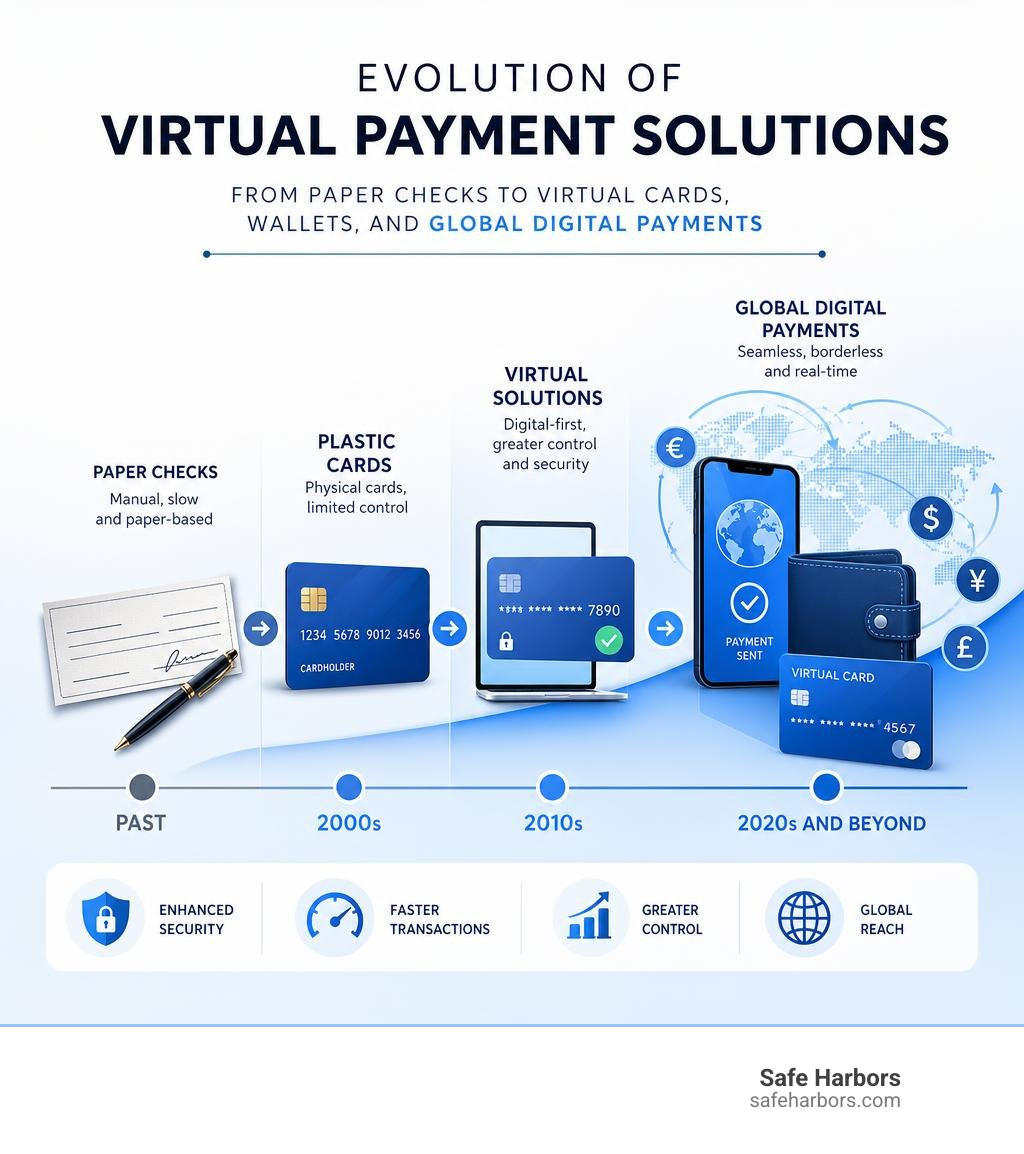
Traditional banking relies heavily on manual intervention. Think about the classic accounts payable workflow: an invoice arrives, a manager signs off on it, a physical paper check is printed, signed, mailed, and eventually deposited. This legacy process is a bottleneck, vulnerable to mail theft, check washing, and human error.
In contrast, virtual payment processing routes transactions entirely through secure, cloud-based networks. When a transaction is initiated, the system securely routes the payment details to the processor, verifies the funds, and settles the balance in a fraction of the time. To understand how these two worlds stack up, explore our deep dive into Virtual Payment Processing.
| Feature | Traditional Payment Methods | Virtual Payment Solutions |
|---|---|---|
| Primary Media | Paper checks, physical plastic cards, cash | Single-use digital cards, virtual IBANs, APIs |
| Processing Speed | 3 to 7 business days (especially for checks) | Instant or near-instant settlement |
| Reconciliation | Manual matching of invoices to bank statements | Automated, real-time matching via unique identifiers |
| Security Risk | High (susceptible to theft, loss, and fraud) | Extremely low (one-time codes, strict spending limits) |
| Data Richness | Minimal (basic transaction amount and merchant) | Enriched data (custom fields, department codes, invoice IDs) |
Virtual Cards and Single-Use Accounts
Perhaps the most dynamic tool in the virtual toolkit is the virtual card. A virtual card is a digital payment card generated entirely online. It features a randomly generated, unique 16-digit number, an expiration date, and a CVV code.
These cards are highly customizable. Finance teams can configure strict spend controls, defining exactly how much money can be spent, the specific date range the card is active, and even which merchant categories (such as airlines or hotels) are authorized to accept it.
The gold standard of security in this space is the single-use account. These are virtual credit cards coded for a specific supplier and a exact transaction amount. Once the transaction is processed, the card number instantly becomes invalid. Even if a bad actor manages to intercept the card details, they cannot reuse them.
Globally, the scale of this technology is massive. Major institutions like J.P. Morgan, currently the largest commercial card issuer on Mastercard and Visa rails as a virtual card issuer in the B2B space, have deployed these tools to help enterprises automate payments and manage risk.
If you are curious about how these cards operate under the hood, you can explore the specialized offerings from fintech platforms like Virtual Cards | Vepay. For corporate travel programs, implementing these systems yields immediate operational dividends. Learn how this technology protects your travelers and simplifies budgets by reading about Virtual Pay VPay Card Benefits.
Virtual Bank Accounts and Local IBANs
For companies trading internationally, traditional cross-border banking is notoriously difficult. Opening physical bank accounts in every country you do business in requires a mountain of paperwork, local entity registration, and endless administrative headaches.
Virtual bank accounts solve this by establishing digital accounts linked to a master corporate account. Through these systems, businesses can instantly generate local IBANs (International Bank Account Numbers) in multiple countries. This allows global clients to pay you using local payment rails like ACH in the United States, Fedwire, or SEPA in Europe, avoiding expensive international wire fees and slow SWIFT processing times.
For platforms managing high volumes of transactions across Europe and the UK, utilizing a Virtual Account - Mangopay allows them to instantly attach local accounts to their digital wallets, automating payment collections and lowering FX costs.
Similarly, developers and businesses looking to capture North American revenue can leverage dedicated APIs to set up fixed, dedicated accounts. To see a step-by-step technical breakdown of how these accounts are provisioned and credited, refer to the documentation on Accepting payments with USD Virtual Bank Accounts.
Virtual Terminals and Digital Wallets
Not every transaction occurs via an API or an automated ERP run. Sometimes, businesses need to accept payments on the fly, over the phone, or through remote sales teams. This is where virtual terminals come in. A virtual terminal is a secure, web-based portal that allows merchants to process touchless payments from any internet-connected device. Instead of swiping a card through a physical reader, a representative logs into a secure dashboard and manually enters the payment details.
To manage the flow of these funds, modern software platforms rely on digital wallets and multi-layer accounts. These systems go beyond simple storage; they allow platforms to segregate funds, manage sub-ledgers for individual users or gig workers, and control user access. For a technical overview of how multi-layer architectures help platforms scale, check out Virtual Wallets & Multi-Layer Accounts | Built for Software Platforms.
Strategic Benefits and Security of Virtual Payments
The shift toward virtual payment infrastructure is driven by clear business utility and consumer utility. For consumers, virtual payments offer instant, touchless convenience and the peace of mind that their actual bank credentials are never exposed. For businesses, the benefits are even more profound: improved working capital, faster transaction speeds, and massive cost savings on transaction fees and manual labor.
How Virtual Payment Solutions Enhance Security and Prevent Fraud
Security is the single greatest argument for abandoning physical cards and paper checks. Traditional corporate credit cards are a security nightmare. If a physical card is lost, stolen, or compromised in a data breach, the company must cancel the card, wait for a replacement, and update every single recurring software subscription or supplier agreement tied to that card number.
Virtual payment systems bypass this vulnerability entirely through tokenization and advanced encryption. When a virtual card is issued, the system creates a "token" (the temporary 16-digit number) that represents the underlying corporate account but has no value outside of its programmed constraints.

Because each transaction uses a unique identifier, virtual payments dramatically reduce the risk of data breaches. Even if a hacker breaches a vendor’s server and steals the virtual card number, they cannot use it. The card has likely already expired, is locked to a different merchant, or is restricted to an exact dollar amount.
Furthermore, virtual terminals and corporate dashboards are protected by robust SSL encryption, multi-factor authentication (MFA), and real-time fraud monitoring systems that use machine learning to flag suspicious behavior before a transaction is even approved.
Optimizing Cash Flow, Working Capital, and Reconciliation
For corporate finance teams, reconciliation is often a dreaded, labor-intensive chore. When physical cards or checks are used, accountants must manually match bank statements to receipts and invoices.
Virtual payments contain detailed, enriched remittance information. Because each virtual card number serves as a unique payment identifier, the transaction automatically maps back to the specific invoice, purchase order, or department that generated it. This enables automated reconciliation, saving accounting teams hours of manual labor and drastically reducing human error.
Additionally, virtual payment programs can optimize working capital. By paying suppliers via virtual credit cards, businesses can extend their days payable outstanding (DPO) — keeping cash in their accounts longer — while ensuring the supplier is paid instantly.
Even better, many virtual card providers offer revenue-share programs. Because virtual card transactions generate interchange fees, providers often share a portion of this revenue back with the business in the form of rebates. Switching from paper checks to virtual card payments can actually transform your accounts payable department from a cost center into a revenue-generating asset.
To begin optimizing your corporate cash flow, explore our comprehensive Spend Management Solutions. To see how automated data capture eliminates manual errors, read our guide on Automated Spend Analysis.
Implementing and Integrating Virtual Payments
Transitioning to virtual payments does not require tearing down your entire financial infrastructure. Modern virtual payment platforms are designed to sit on top of your existing business systems, acting as a bridge that enhances operational efficiency without disrupting day-to-day work.
System Integration via APIs and ERPs
The key to unlocking the full power of virtual payments is seamless system integration. Rather than requiring staff to log into separate portals to generate card numbers, modern payment providers offer robust API endpoints. These APIs allow your Enterprise Resource Planning (ERP) systems (such as SAP, Oracle, or NetSuite) to automatically request, issue, and assign virtual cards the moment a purchase order is approved.
This real-time tracking ensures that your ledger is updated instantly, giving leadership a clear, live view of corporate spend. For businesses exploring cutting-edge payment rails, platforms like FiatPay — Multi-Chain Stablecoin Payment Gateway show how APIs can bridge the gap between traditional currency and digital assets.
On a global scale, services like Mastercard Move - Set money in motion | Mastercard Global leverage a single integration point to reach 95% of the world's banked population across 200+ countries, proving that complex global money movement can be simplified into a unified digital workflow.
Compliance, KYC, and Regulatory Considerations
While virtual payments offer incredible speed and efficiency, they must operate within strict regulatory frameworks. Any platform issuing virtual accounts or processing digital transactions must implement rigorous KYC (Know Your Customer) verification and AML (Anti-Money Laundering) compliance checks.
This ensures that virtual accounts are not used for illicit activities or unauthorized cross-border transfers. In Europe and the UK, regulations like PSD2 (Payment Services Directive 2) and the emerging PSD3 framework mandate strong customer authentication (SCA) to protect consumers and businesses alike.
When deploying virtual payment systems, organizations must ensure their technology partners adhere to the highest standards of data privacy, including PCI-DSS (Payment Card Industry Data Security Standard) compliance, to keep sensitive financial data fully encrypted and secure.
Overcoming Challenges When Adopting Virtual Payment Solutions
Despite the clear benefits, implementing a new payment system can present hurdles. The most common challenge is supplier enablement. Some traditional vendors may be hesitant to accept virtual card payments due to concerns over credit card processing fees or unfamiliarity with the technology.
Overcoming this requires active supplier education. Highlighting that virtual payments settle instantly — eliminating the wait for physical checks to clear — is often enough to get vendors on board.

Additionally, businesses must navigate technical integration challenges and manage their internet dependency. Because virtual payments rely entirely on cloud networks, a reliable network infrastructure is mandatory.
Finally, finance teams must carefully analyze transaction fees. While some virtual payment methods carry processing costs, these are typically offset by the operational savings of automated reconciliation and the cash-back rebates generated by virtual card programs.
Frequently Asked Questions about Virtual Payments
Which industries benefit most from virtual payment solutions?
While almost any modern enterprise can benefit from going digital, certain sectors see immediate, transformative results:
- E-commerce and Marketplaces: Instant virtual accounts allow global platforms to collect multi-currency payments from buyers and instantly route payouts to international sellers.
- The Gig Economy: Ride-sharing, delivery, and freelance platforms use virtual wallets to give contract workers instant, 24/7 access to their earnings.
- Corporate Travel: Managing travel expenses is notoriously complex. Virtual cards solve this by allowing travel managers to issue single-use cards for specific flights, hotels, and meals, keeping employees on-budget and eliminating the need for personal expense reports.
To learn how to structure your corporate travel budget, check out our Corporate Travel Spend Guide. To discover how to leverage digital payment tools to cut travel costs, read about how to Optimize Business Travel Spend.
How are virtual payments evolving with AI and blockchain?
The future of virtual payments is closely tied to emerging technologies. Artificial Intelligence (AI) is being deployed to perform real-time fraud detection, analyzing transaction patterns in milliseconds to block unauthorized charges. AI also automates ledger matching, identifying discrepancies in remittance data without human intervention.
On the security front, biometric authentication — such as facial recognition and fingerprint scanning — is replacing traditional passwords to authorize high-value corporate transfers.
Meanwhile, blockchain technology and smart contracts are paving the way for decentralized, trustless payment networks, enabling instant, zero-cost cross-border settlements that bypass traditional banking intermediaries entirely.
Do businesses need a traditional bank account to use virtual cards?
Strictly speaking, no. While many enterprises link virtual card programs directly to their existing corporate bank accounts, many modern financial technology platforms allow you to operate entirely through digital wallets.
In this setup, a business funds a secure digital wallet via a bank transfer or a digital deposit. Once the wallet is funded, the platform can instantly generate virtual cards for global online spending and subscription management. This model is highly valuable for international businesses or startups that need to establish global spending capabilities quickly without navigating the bureaucratic hurdles of traditional banking setup.
Conclusion
Implementing virtual payment solutions is no longer just an IT upgrade; it is a fundamental business strategy. By replacing outdated, manual processes with secure, automated, and data-rich digital alternatives, organizations can protect themselves from fraud, slash administrative overhead, and unlock vital working capital.
At Safe Harbors, we understand that managing corporate travel spend is one of the most complex financial challenges an enterprise faces. As a premier global corporate travel management company, we provide fast-response support, elite tech partnerships, and white-glove concierge management with a strict commitment to duty of care. Our global footprint and unmatched response speed ensure your travelers are supported anywhere in the world, while our cutting-edge payment integrations keep your finance team in complete control.
Ready to take control of your travel budget? Dive into our Travel Spend Management Complete Guide to build a modern corporate travel policy. To understand where your travel dollars are actually going, read our guide on Spend Category Analysis.
If you are ready to modernize your corporate travel program and eliminate manual expense reports forever, Discover the benefits of virtual payment solutions with Safe Harbors today.